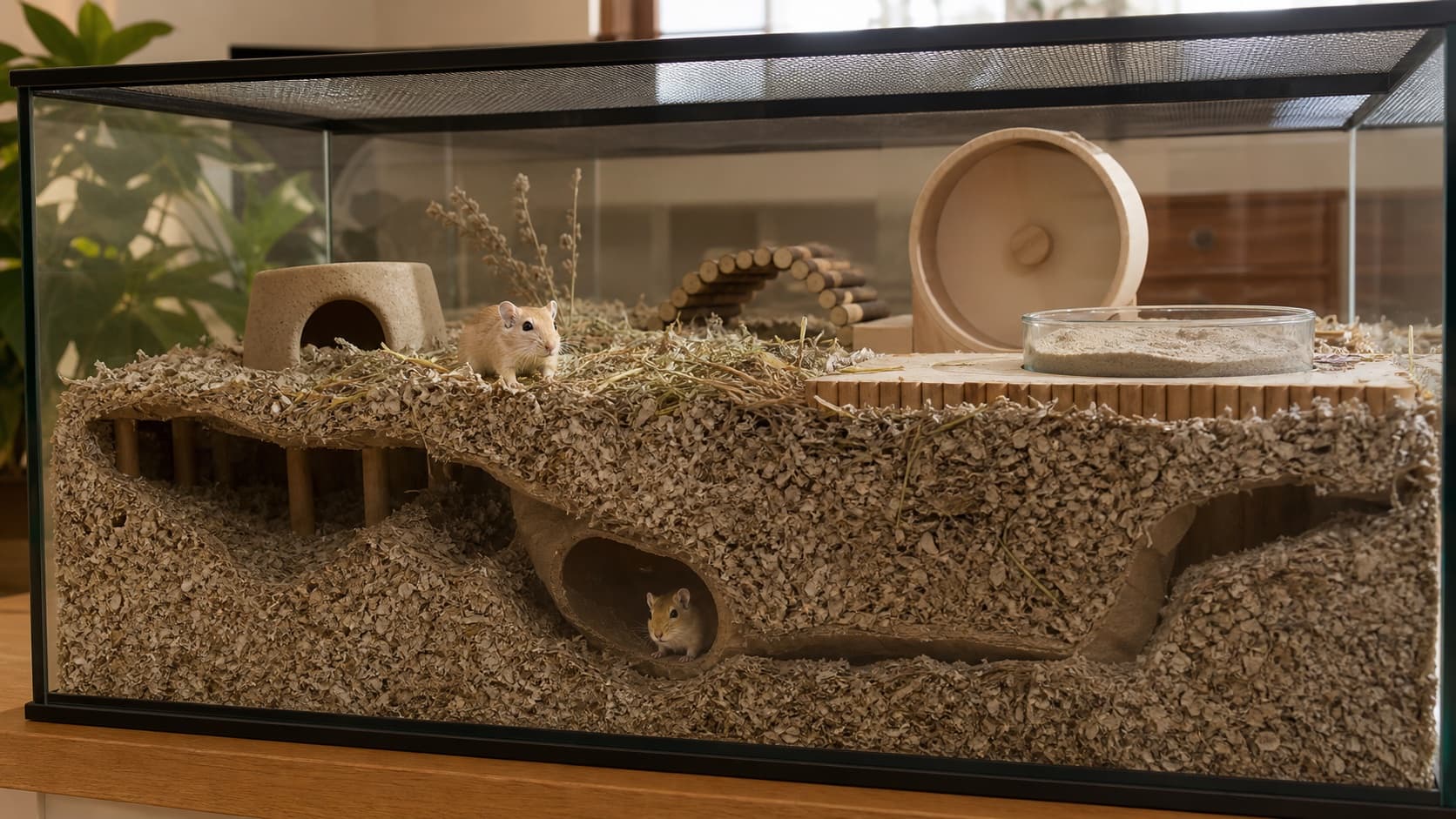
A gerbil home is mostly below the surface. The enclosure must hold a deep, stable burrow system while leaving a safe surface for water, a wheel, sand, food, and daily access. Start with the shell, then design the substrate and equipment as one connected habitat.
The Blue Cross gerbil care guide recommends at least 100 cm by 40 cm of floor surface and 40 cm of height for two to four gerbils. Woodgreen's current housing guide uses a roomier 100 cm by 50 cm by 50 cm minimum for a pair, which is the benchmark used by the product-title safety gate. The RSPCA environment guide calls for solid glass walls, a solid floor, a secure wire-mesh top, shelter, digging room, and exercise space.
Begin with the glass footprint
Choose a large glass tank or purpose-built gerbilarium with a solid base and tightly fitted ventilated mesh lid. Measure the clear internal length, width, and height. Account for any frame, topper, platform, bottle, or lid hardware that reduces usable room.
The lid should close securely after the deepest realistic substrate level is added. Ventilation must remain open across the top. Leave enough working room around the enclosure for an adult to remove the lid, reach the water bottle, inspect the sand, and lift a carrier safely.
Divide depth from the service area
Most of the enclosure should support digging. A stable partition or raised platform can keep a wheel, water bottle, and sand bath usable while bedding moves around them.
Build the substrate from materials that can interlock:
- Dust-extracted paper bedding for volume and absorption.
- Hay for long fibers and tunnel structure.
- Plain shredded paper for nesting.
- Cardboard tubes, boxes, and dividers embedded as starter structure.
The exact finished depth depends on the enclosure, but it should allow the pair to make connected tunnels and nest below the surface. The MSD Veterinary Manual recommends filling the enclosure about one-third deep with bedding as a starting point for digging and food storage. A purpose-built modern gerbilarium can devote substantially more of its lower volume to burrowing when ventilation and safe equipment access are preserved.
Give the pair one connected territory
Provide one shared nest area large enough for the pair. RSPCA recommends a dark nest box with enough room to move and multiple entrances so one animal cannot block the other. Plain cardboard, ceramic, or chew-safe untreated wood works better than exposed soft plastic for a species that constantly gnaws.
Add several routes through and around the bedding rather than separating the home into small sealed compartments. Cardboard tubes can begin below the surface and then disappear into the substrate as the gerbils rebuild them.
Fit the surface jobs
Every surface object needs a clear job:
- A solid wheel supports running without open bars catching feet or tails.
- A stable sand dish supports coat care.
- A protected water bottle provides reliable access and remains easy to test.
- A ceramic food bowl can hold part of the complete food while the rest is scattered for foraging.
- Cardboard and suitable untreated wood provide shredding and chewing.
- A flat stone or tile adds a stable lookout and rough surface.
Keep a clear route between these stations. Watch the first evenings to see whether one object creates a bottleneck or whether bedding repeatedly buries the water nozzle.
Choose a quiet indoor room
Keep the gerbilarium indoors, away from direct sunlight, radiators, fireplaces, smoke, aerosols, strong drafts, and constant vibration. Blue Cross notes that gerbils can be active during the day, evening, and night, so a bedroom may be difficult for the people sleeping there.
A waist-height stand usually makes daily observation and care easier. Confirm that the furniture supports the filled enclosure's weight and cannot wobble.
Run the completed-home check
Before the pair enters:
- Press on the lid and test every clip.
- Check that the ventilation remains fully open.
- Shake each platform and heavy object.
- Test the water bottle and confirm the nozzle remains reachable.
- Spin the wheel and check clearance from bedding and walls.
- Run a hand along cut cardboard, wood, mesh, and platform edges.
- Confirm that the carrier can reach the opening without an exposed gap.
- Photograph the finished layout so later movement is easy to spot.
The gerbils will redesign the interior. That is the point. A good setup gives them safe materials and stable boundaries for that work.