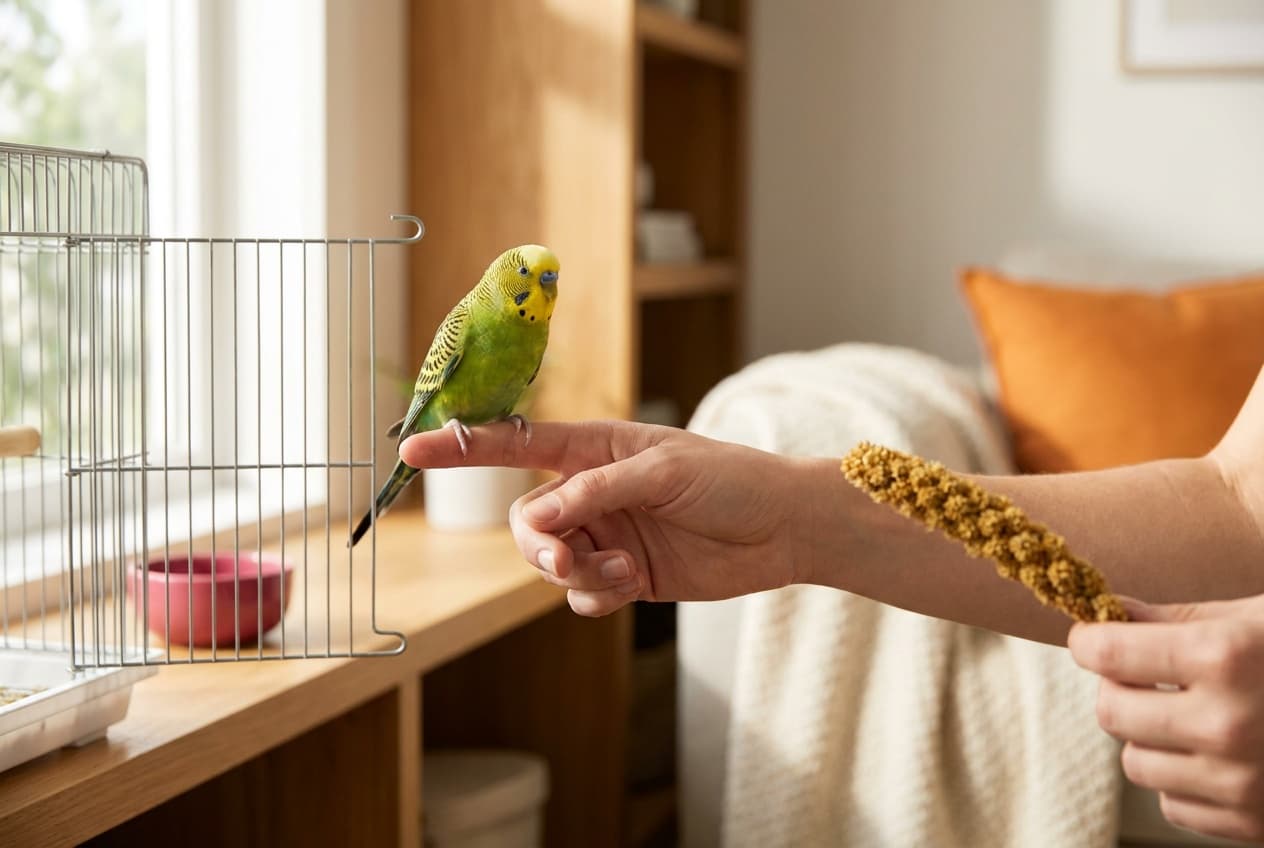
Taming a budgie is a sequence of small yeses. Each stage ends with the bird choosing to stay, and the next stage starts only when the current one looks easy. The RSPCA training guidance frames handling as something a bird learns to accept through gradual, reward-based steps, and that framing is the whole method: no grabbing, no chasing, no towel-and-hold shortcuts for everyday handling.
Stage one: be furniture
Start after the budgie already eats, moves, and chatters normally while you are in the room. Sit near the cage at the bird's level for short, regular sessions. Talk quietly. Read aloud if it helps you stay boring. You are done with this stage when your arrival no longer changes the bird's behavior.
Stage two: the hand becomes a feeder
Rest a hand on the outside of the cage during calm moments, then offer a favorite item, often a millet spray, through the bars. Hold still and let the budgie close the distance. Keep sessions to a few minutes and end before interest fades. When bars-feeding is instant and relaxed, offer the same item through the open door from a flat, still hand.
Stage three: the perch test
Inside the cage, hold a spare natural perch horizontally near the bird's chest, just above the feet, and give a consistent quiet cue such as step up. Most budgies step onto a familiar perch before a finger. Reward the step immediately. When perch step-ups are reliable, substitute a finger held the same way and keep the cue identical.
Stage four: the door opens
Run step-up practice with the door open, letting the budgie ride your hand just outside the cage and straight back in. The return trip matters as much as the exit; a bird that learns hands always lead back home stops treating the cage door as a trap. Only expand to room time once the room-safety checklist is done, covered in the out-of-cage guide.
Two birds, same method
A bonded pair tames on the same steps with more patience. Work with whichever bird approaches first; the second often learns by watching. Progress is slower and the birds will always prefer each other, which is the correct outcome for the species.
When progress stalls
Backsliding usually means a stage was rushed or a session ran long. Return to the last easy stage for several days. A budgie that suddenly becomes unusually inactive, fluffed, or uninterested in food is not being stubborn; that is a health question for a veterinarian who treats birds, not a training problem.
Pair this with the sleep and room-safety guides so practice sessions land in a calm, safe part of the day.