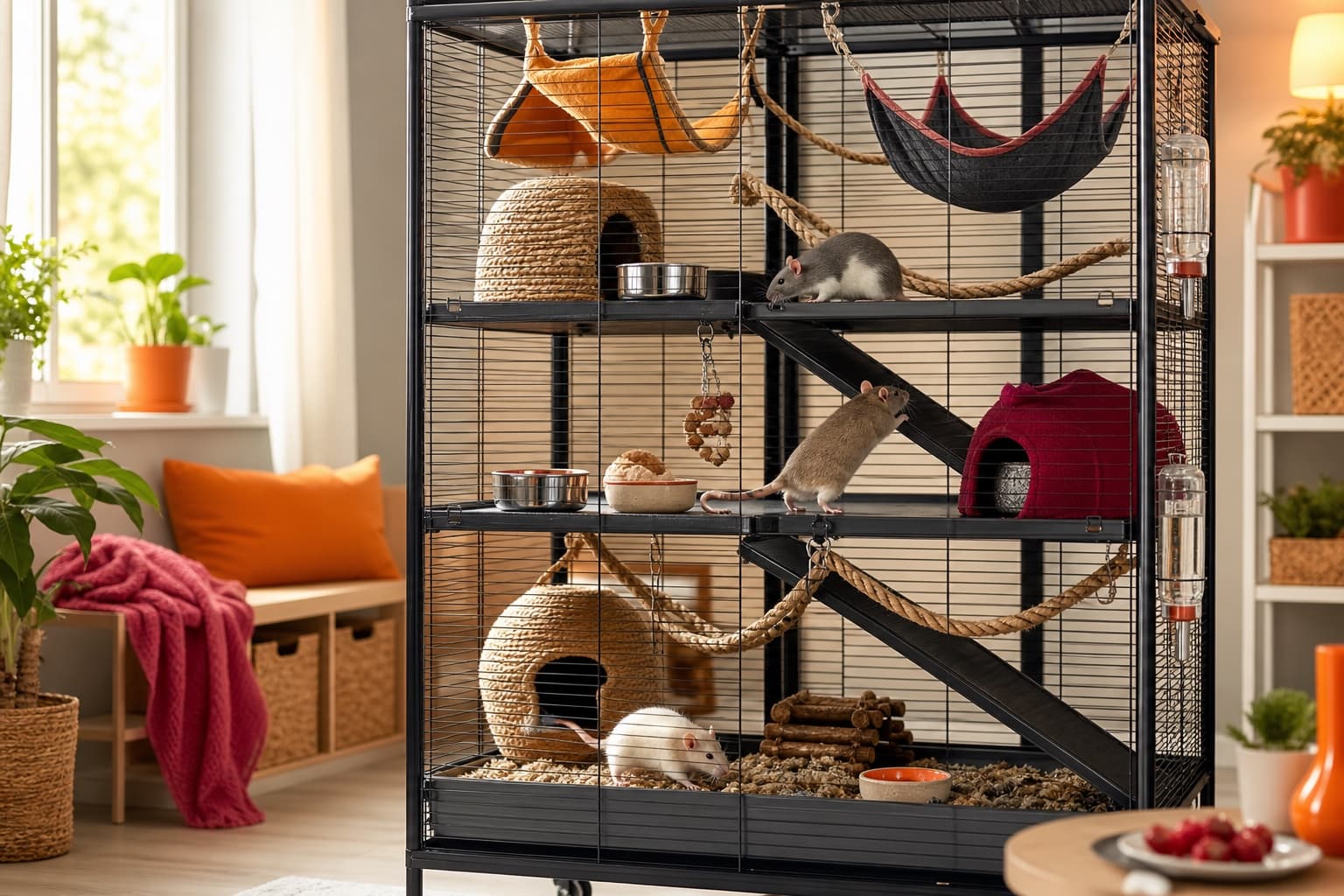
A good rat cage is a vertical home, not an empty tower. The useful measure is how much of the height becomes a connected route through solid platforms, hammocks, hides, feeding points, digging material, and places to pause together or apart.
The RSPCA rat environment guide emphasizes climbing, exploring, digging, nesting, hiding, and foraging. The cage should support those jobs while remaining secure, ventilated, dry, and easy to inspect every day.
Start with secure ventilation and usable room
Choose a strong wire cage with close bar spacing and reliable latches. Wire sides provide airflow and attachment points for hammocks, ropes, branches, and platforms. Use solid floors and solid shelf surfaces. Cover exposed mesh so feet do not spend ordinary time on wire.
Blue Cross recommends at least 90 cm long by 60 cm deep by 120 cm high as living space for two to five rats. Treat that figure as a starting benchmark, then consider the number and size of rats, how much of the volume is usable, and whether the group can move without bottlenecks.
Glass aquariums and tank-style homes have limited ventilation. Tiny starter cages, travel cages, and playpens are not permanent housing.
Turn height into a route
Map the cage from the floor upward. A rat should be able to move between important resources without making one long exposed drop. Use broad shelves, stable ramps, cargo nets, ropes, and hammocks to create several paths.
Place a solid landing surface beneath any higher climbing feature. Keep heavy objects low and stable. Check clips, seams, hooks, and chewing damage during ordinary cleaning.
Distribute the essentials
Do not make one corner carry the whole routine. Spread resources so one rat cannot easily control every valuable point.
- Provide more than one water source and test each one daily.
- Use several covered sleeping places and hammocks.
- Offer food in a stable dish and scatter part of the same daily allowance for foraging.
- Add cardboard boxes, tubes, paper bags, ropes, and untreated rat-safe materials to investigate.
- Create a deep digging area with suitable material.
- Keep plain nesting paper within easy reach.
The MSD Veterinary Manual housing guide also highlights ventilation, safe bedding, hiding places, and opportunities for exercise.
Choose the room with the cage
Place the cage indoors where the household can notice the rats without surrounding them with constant noise. Avoid direct sun, radiators, fireplaces, smoke, aerosols, cooking fumes, and strong drafts. Protect daytime sleep, since rats are commonly most active around dusk, night, and dawn.
Raise the cage enough that ordinary activity is not always happening over the rats from above. Leave working room around the doors and base so an adult can reach every water point, shelf, fastener, and wet corner.
Build an easy maintenance path
A beautiful setup that cannot be inspected will become harder to keep dry and safe. Wide doors, removable solid trays, washable shelves, and reachable clips matter. Keep the carrier nearby so the group has a familiar secure place during a full clean or room change.
Remove wet or spoiled material when you find it. During fuller cleaning, keep a small amount of clean, dry familiar nesting material so the home does not return completely scentless. Rotate cardboard and low-cost enrichment instead of rebuilding the entire layout at once.
Check the completed home
Before the rats enter, run both hands along cut edges, sharp clips, gaps, and loose fabric threads. Shake each shelf and ramp. Test every latch and water source. Look from rat height for tight spaces, long drops, and routes that end in conflict.
Then watch how the group actually uses the cage. A shelf ignored by every rat, a narrow route that creates shoving, or a water bottle that only one animal can approach comfortably is useful information. Adjust the home around observed behavior.