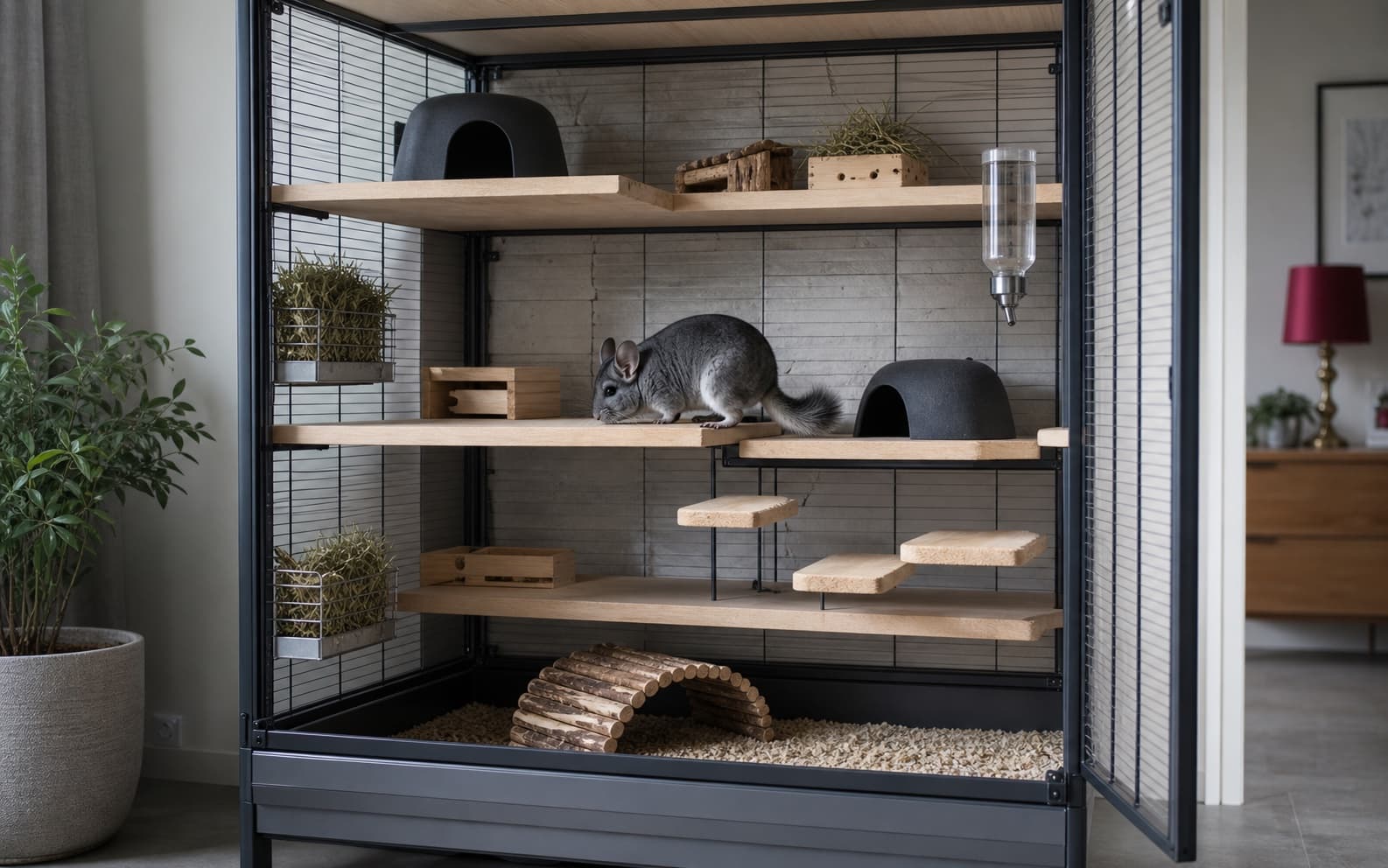
A chinchilla home should make height usable, not merely impressive. Broad solid shelves, short routes, covered resting places, and duplicate resources for companions turn a tall frame into a place where a chinchilla can climb, pause, hide, eat, and move with control.
The Blue Cross chinchilla guide gives 90 cm long by 60 cm deep by 120 cm high as a minimum enclosure for a pair or trio. Treat those figures as a starting boundary and compare the internal usable space, shelf plan, and access rather than the advertised outside dimensions alone.
Start with height and depth together
Look for a secure indoor enclosure with strong ventilation, a solid base, and doors large enough for daily care. Height supports climbing, while depth gives shelves enough room to be broad and stable. Closely spaced bars should prevent escapes and keep heads or limbs from entering unsafe gaps.
The MSD Veterinary Manual housing guide recommends a large multilevel cage and cautions that chinchillas chew readily. Inspect plastic ledges, coated wire, clips, and trim as potential chew points.
Draw the landing route first
Place broad solid shelves so each jump has a clear destination and a short fall path. Stagger levels rather than creating one open vertical drop through the center. Add a wide shelf beneath higher routes where useful, and make sure every surface stays rigid under movement.
Check the setup from the chinchilla's eye level:
- Can it move between levels without squeezing past a bottle or hay rack?
- Is there a broad landing point after each jump?
- Can a resting chinchilla leave a shelf without being blocked by a companion?
- Are edges smooth and fixings covered?
- Can an adult remove and clean each shelf safely?
Give every chinchilla a choice
For a compatible pair, provide more than one hide and more than one comfortable route to hay and water. A hide should be dark, stable, ventilated, and large enough to enter and turn around. Avoid a layout where one animal can control the only doorway or the only route between levels.
Use untreated chinchilla-safe wood and sturdy chew items. The RSPCA behavior guidance calls for wood blocks or branches for chewing, shelves at different levels, hiding places, daily exercise, and social contact.
Fit food, water, and bathing access
Place hay where it stays clean and can be reached from a solid stance. Secure the water source at a comfortable height and test the flow every day. Use a heavy pellet bowl or a firmly attached feeder that cannot be tipped into the floor tray.
The dust bath needs enough clearance for rolling and an entrance that does not scrape the back. Because the bath is usually offered and removed, choose a door and shelf position that allow it to move in and out without chasing the chinchilla.
Design for the person doing the care
Large doors make it easier to replace hay, check water, spot-clean, inspect shelves, and move a carrier into place. A removable tray can help, but only when it slides without opening an escape route. Lock casters before use and test every latch.
Keep the enclosure off direct sun and away from heat, steam, drafts, and constant noise. Cage quality cannot compensate for a room that becomes too warm.
Build the cage and the room placement as one decision. The separate room-temperature guide covers the environmental half of the setup.