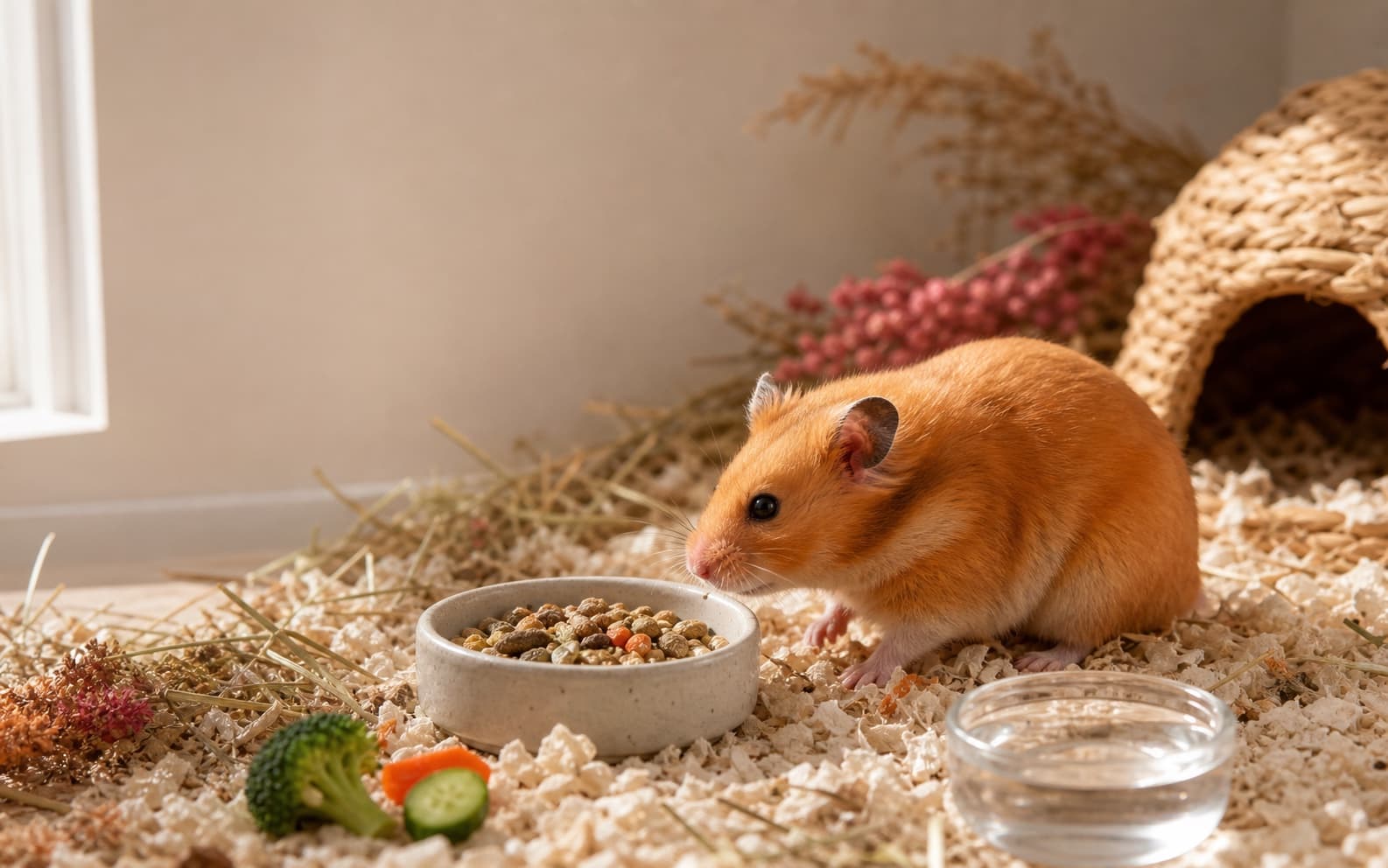
Hamsters are omnivores. Their daily routine should begin with a complete food formulated for hamsters, continuous fresh water, and measured fresh additions that do not replace the balanced base. A portion of the dry food can be scattered to support normal searching and carrying behavior.
The Animal and Veterinary Service of Singapore recommends mostly formulated rodent pellets, with smaller amounts of seeds, grains, and occasional fresh foods. UC Davis School of Veterinary Medicine also warns that a hamster can selectively eat favored seeds from an unbalanced mixture while leaving the more complete pieces behind.
Start with one complete food
Choose a food labeled for the hamster species and life stage in front of you. Read the package directions and use the manufacturer's serving guidance as the starting point for that specific product. A veterinarian who treats hamsters can help adjust the plan for an individual animal.
When a hamster comes home, ask what it has been eating and bring some of the same food if possible. Make any change gradually. A sudden full swap makes it difficult to tell whether reduced eating reflects preference, stress, or a health problem.
Store dry food sealed, cool, and dry. Check the date and the condition of the bag before serving. Discard food that smells stale, feels damp, or shows insects or mold.
Make water easy to verify
Provide fresh clean water every day. A bottle should release water when the tip is touched, remain securely mounted, and stay within comfortable reach. A stable bowl should resist tipping and sit where bedding is less likely to be kicked into it.
Whichever format you use, look at it daily. A full bottle can still have a blocked or leaking spout, and a bowl can be contaminated between routine refills.
Add fresh food in small, observable portions
Introduce one fresh item at a time in a small amount so you can see whether it is eaten and how the hamster responds. Wash produce and remove uneaten fresh food before it spoils or disappears into a warm food store.
Fresh additions can add variety, but they should remain additions. A colorful plate of fruit, vegetables, nuts, and treats can easily overwhelm the complete food and make selective eating more likely.
Turn part of dinner into foraging
Scatter a portion of the measured dry food across clean bedding, place it in a cardboard tube, or tuck it around safe cover. The BC SPCA hamster guide describes nighttime travel and food gathering as central natural behaviors.
Foraging should make the same daily food more engaging, not add an unlimited second ration. Keep enough of the meal visible at first to confirm that a new hamster is eating.
Notice changes promptly
Learn how much food disappears during a normal evening and where the hamster usually stores it. Also watch drinking, droppings, movement, posture, and normal nighttime activity. A marked change in eating, drinking, droppings, breathing, or energy warrants prompt veterinary advice.
A steady feeding plan is intentionally simple: complete food, reliable water, modest variety, and enough observation to notice when the routine changes.