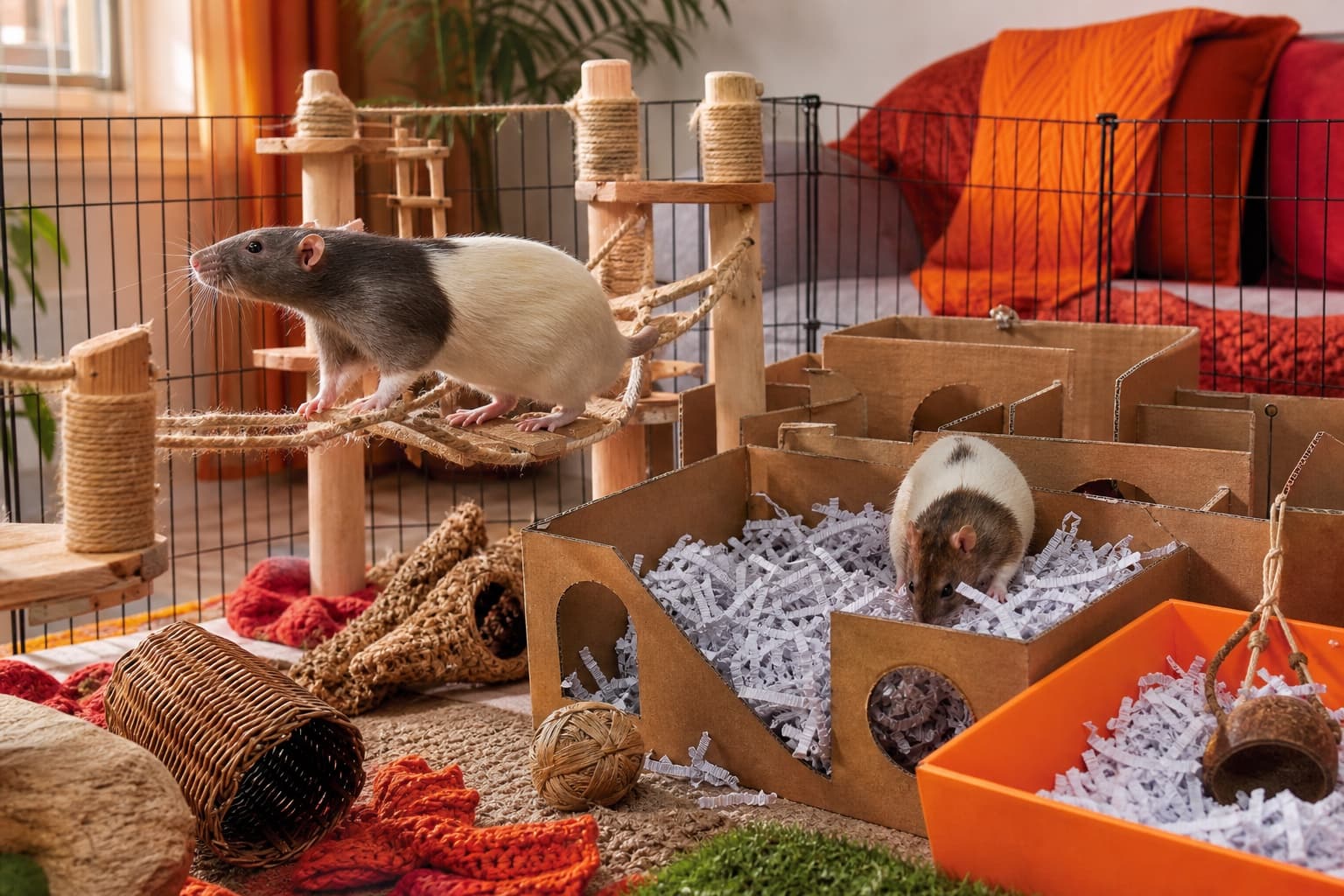
Pet rat enrichment becomes easier to plan when it is organized around jobs rather than products. A useful week gives a compatible group repeated chances to climb, dig, forage, nest, and learn. Cardboard, paper, safe routes, and a few reusable objects can do more than a crowded cage full of untouched toys.
The RSPCA rat behavior guide describes rats as intelligent, curious animals that need opportunities to explore, forage, play, and learn. Blue Cross also recommends changing activities and using safe household materials to keep the environment interesting.
1. Climb through connected routes
Use broad shelves, hammocks, ropes, nets, ladders, and stable branches to create more than one path through the cage. Put solid landing surfaces under higher features and inspect fabric, clips, and chewed edges regularly.
Change one section at a time so the cage remains understandable. A new rope route is more useful when it connects two places the rats already value, such as a sleeping level and a foraging shelf.
During supervised free-roam time, use low stools, boxes, platforms, and an open carrier to create a second climbing landscape. Keep heights modest and landings padded.
2. Dig into a real substrate
Offer a deep, stable container filled with a suitable dust-free digging material such as clean paper-based substrate. Make the container large enough for turning and active digging, with an easy entrance and a base that cannot tip.
Hide a few pieces of the ordinary daily food at different depths. Replace damp or soiled material and check that long fibers or loose threads are not winding around feet.
3. Forage for part of the daily food
Set aside part of the complete daily food and use it across several activities:
- Scatter it through clean paper bedding.
- Fold pieces into a plain cardboard egg box.
- Place food inside crumpled paper in a shallow tray.
- Use a reusable puzzle with openings large enough for safe access.
- Hide small portions across different cage levels.
Spread the opportunities so every rat can participate. Foraging should not turn one bowl into one guarded puzzle.
4. Nest and remake the sleeping space
Offer plain shredded paper, tissue, cardboard, and several covered sleeping options. Rats may carry material between levels, line a hammock, block an entrance, or rebuild after cleaning.
Preserve a small amount of clean, dry familiar nesting material during a fuller clean. This lets the rats keep useful scent information while still returning to a dry home.
Avoid fluffy nesting wool and long stringy fibers that can tighten around limbs. Inspect fabric hides and hammocks for loose threads and damaged seams.
5. Learn through short training
Rats can learn to approach a hand, enter a carrier, move to a platform, follow a target, and respond to a name or sound cue. Keep sessions short, quiet, and voluntary. Mark the desired action consistently and use a small piece of the daily food as reinforcement.
Carrier training is especially useful because it turns routine transfers into a familiar behavior. Begin with the carrier open in the cage or play area, add comfortable familiar material, and reward investigation.
Build a weekly rhythm
Keep the core home stable while rotating a few low-cost materials. Cardboard can become a maze, tunnel, platform, forage box, or shredding project. Paper can become bedding, wrapping, or a trail to follow. The Blue Cross enrichment guide offers similar ideas built around species-appropriate movement and investigation.
Watch what the rats choose. An activity that is never approached may be too exposed, unstable, difficult, or simply uninteresting. Move it, simplify it, or replace it. Enrichment is successful when it produces confident behavior, not when it fills every empty space.
Exercise balls are not a substitute for a safe room. RSPCA advises against them because the enclosed ball restricts normal use of smell, touch, and whiskers and removes the rat's control over leaving.