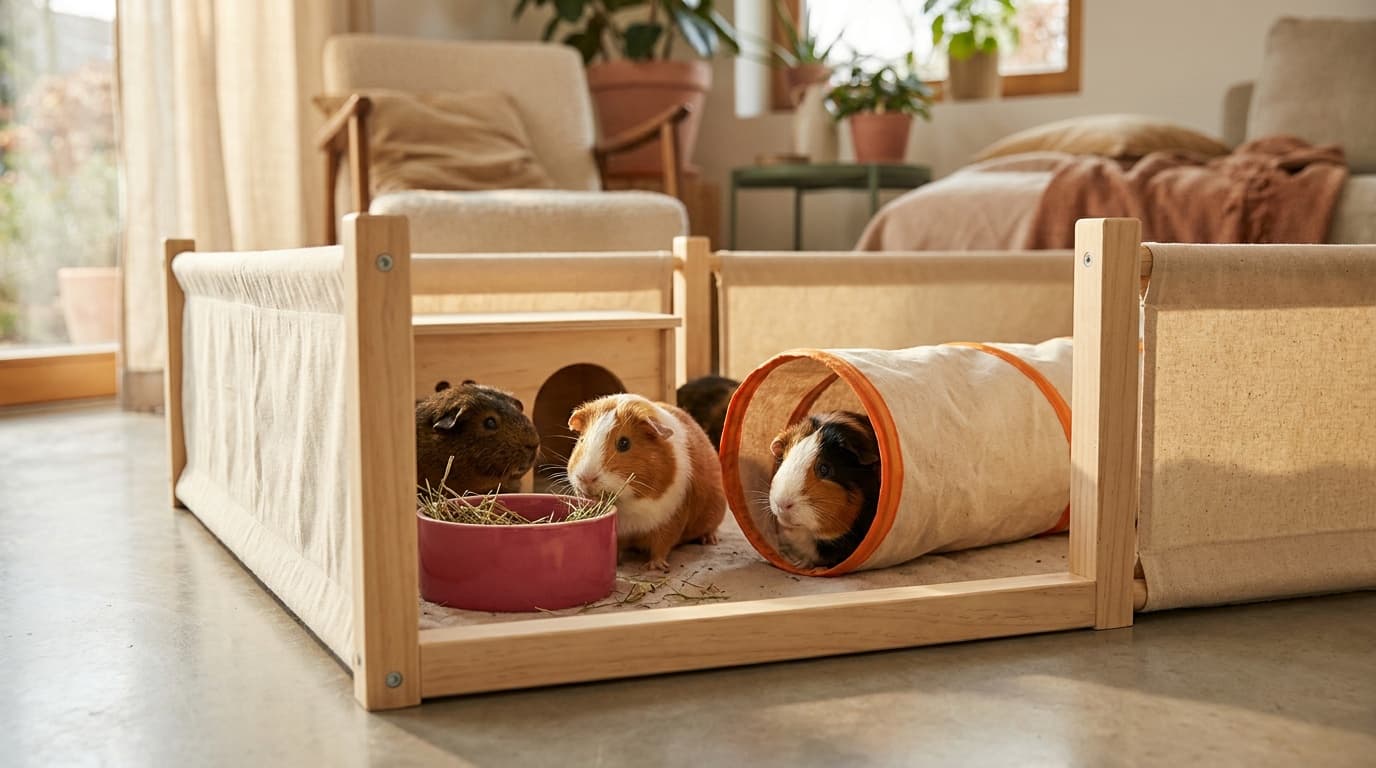
Guinea pig housing should give a compatible pair continuous usable floor space, solid footing, several covered places, and more than one route to hay, water, and rest. Accessories support that floor plan; they should not consume the room needed to run and move around one another.
The RSPCA guinea pig environment guide recommends a secure exercise area, a solid floor, several refuges, tunnels, chew items, and protection from temperature extremes and predators. The Merck Veterinary Manual housing guide also emphasizes adequate floor area, safe materials, and environmental enrichment.
Draw the open floor first
Start with the largest practical continuous enclosure, then preserve a clear route around shelters and feeding points. Guinea pigs move horizontally, so a tall cabinet-style cage does not replace floor area.
Use a solid base with dry, absorbent bedding. Avoid wire or grid floors. Check corners and seams for trapped moisture, sharp edges, or gaps where a foot could catch.
For a pair or group, provide:
- Several hay piles or racks.
- More than one water source when practical.
- Separate food locations.
- At least one shelter per guinea pig plus an extra option.
- Tunnels and houses with more than one opening.
Open exits matter because one guinea pig should not be able to trap another inside a shelter.
Choose a quiet, stable location
Place the enclosure away from direct sun, radiators, vents, draughts, kitchens, smoke, and loud equipment. Keep dogs, cats, ferrets, and other potential predators away from the enclosure even when supervised interactions have appeared calm.
Guinea pigs respond poorly to abrupt temperature changes. If the group moves between indoor and outdoor housing, ask a guinea pig-experienced veterinarian or welfare organization how to plan the transition for the local climate.
Add movement and foraging opportunities
Use open-ended tunnels, cardboard boxes, hay piles, and safe chew materials. Scatter part of the usual food through clean hay or across several feeding points to encourage movement without adding extra food.
An attached exercise area is more useful than a separate playpen that appears only occasionally. Reconfigure a few safe objects at a time while keeping the food, water, and primary shelters predictable.
Clean without erasing the whole layout
Remove wet bedding and spoiled food every day. Deep-clean on a schedule that keeps surfaces dry and hygienic without repeatedly leaving the animals in a completely unfamiliar arrangement. Return shelters, hay, and water to recognizable locations after cleaning.
Check each individual during the daily reset. One active guinea pig can make a quiet companion easy to overlook.
Contact a guinea pig-experienced veterinarian when an animal stops using part of the enclosure, moves differently, eats less, produces fewer droppings, or shows a clear change after a housing adjustment.