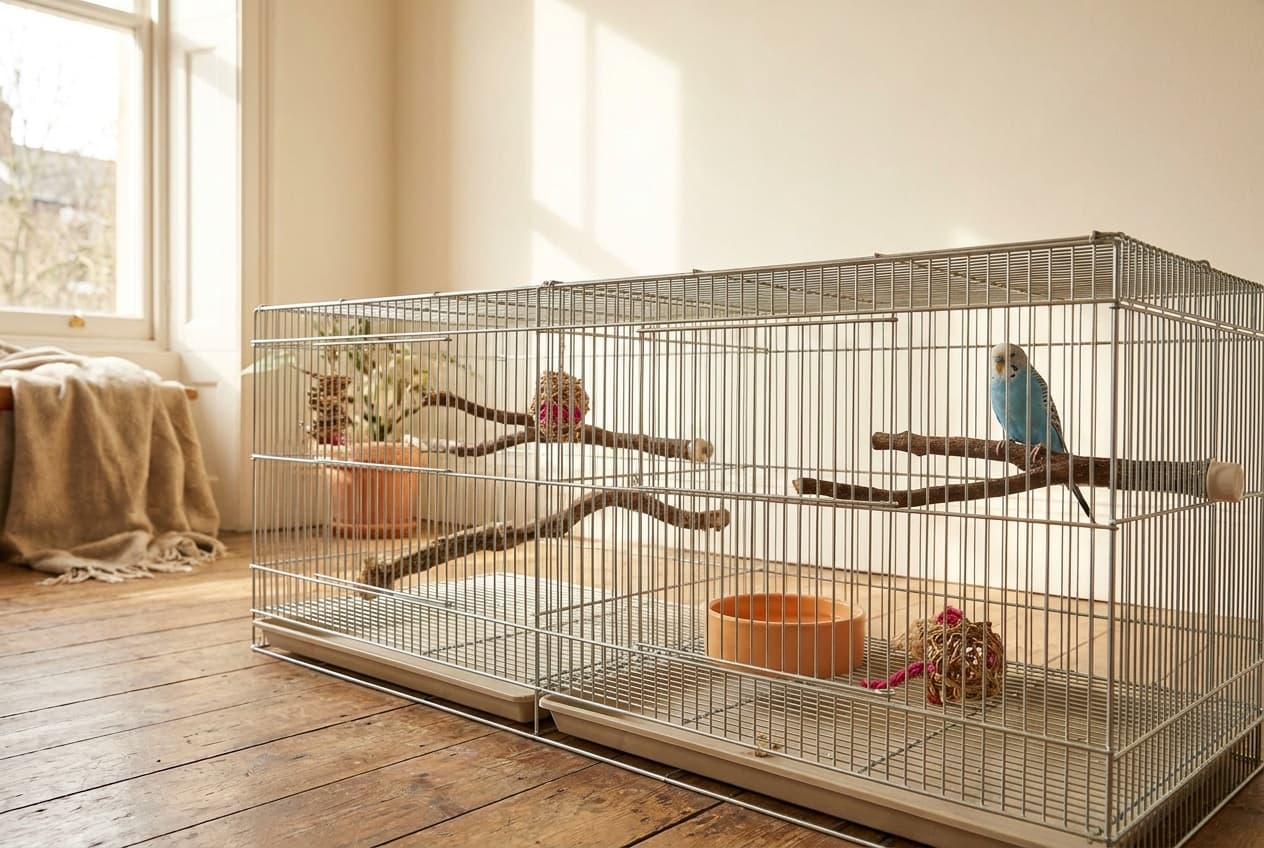
A budgie cage is a flight space first and furniture second. Budgies move horizontally, wing-first, from perch to perch, so the useful cage is wide before it is tall, with clear air between landing points. The RSPCA environment guidance makes room to fly the baseline for every bird kept in a cage, and the MSD Veterinary Manual housing page describes the cage as the primary environment that has to support exercise, not just containment.
Choose width and flight room first
Buy the largest cage the room and budget allow, and prefer a wide rectangle over a tall narrow tower. The flight path is horizontal, so a short wide cage outworks a tall thin one of the same volume. Round cages remove the straight flight line and the corner a bird uses to feel oriented, which is why they are a poor fit for budgies.
Check bar spacing before style. For a bird as small as a budgie, gaps need to be narrow enough that a curious head cannot pass through. Horizontal bars on at least two sides help a budgie climb comfortably.
Vary the perches
Replace any single-diameter plastic dowel run with several natural wood perches of different thicknesses, so the feet grip at different angles through the day. Place perches so droppings cannot fall into food or water, and leave the center of the cage open as the flight lane.
Skip sandpaper perch covers entirely. They do not keep nails short and they abrade the one surface a bird stands on all day. Nail and beak care belong to an avian veterinarian or an experienced professional, as the MSD grooming and routine care page describes.
Use the budgie perch guide to assign each landing a role, then map the branch, side route, and optional flat rest without crowding the middle.
Place food, water, and the bath deliberately
Use separate stations for dry food, fresh food, and water, positioned away from the area under the busiest perch. Add a shallow bath or plan a misting routine, and expect to refresh water daily per the AVS pet bird guidance. Ceramic or stainless dishes clean up better than plastic that scratches.
Position the cage for calm
Set the cage at roughly chest height against a wall, in a room the household actually uses, with no direct sun, no drafts, and no kitchen air. The MSD household hazards page lists fumes from cooking and overheated nonstick cookware, aerosols, and scented products among airborne risks to birds, and the kitchen concentrates all of them.
Keep the cage a safe home base
Latch every door, check for sharp interior edges, and keep the cage floor lined and changed on a regular schedule. The cage should stay the budgie's secure retreat even after daily out-of-cage time begins, so keep food, familiar perches, and the sleeping position consistent.
With the cage settled, the budgie supply plan connects the flight cage, perch map, feeding, play, and travel pieces to the daily routine.