A useful budgie cage does not repeat the same perch in three colors. It gives each landing a job. Start with a varied natural branch, preserve a clear route through the middle, then add a flexible side path or a small flat rest only where it solves a real placement need.
The Association of Avian Veterinarians companion-bird guide recommends natural branches with varied diameters and says sandpaper perch covers should never be used. VCA Animal Hospitals likewise recommends varied sizes, a diameter suited to the bird's foot, and regular checks for splinters, chewing, or frayed rope. The RSPCA bird-environment guide adds the room-level rule: place perches to encourage flight and keep droppings away from food and water.
The measurements below are the manufacturers' published specifications. Fit still depends on the finished cage, the individual bird, and the route between doors, dishes, toys, and landing points.
Map three jobs before you shop
The branch is the foundation. The rope and ledge are optional tools, not a required matching set. A smaller cage may be better with two well-placed surfaces and more open air than three crowded ones.
Swipe or use arrow keys to compare every column.
| Perch | Job in the cage | Published fit | Best placement |
|---|---|---|---|
| Prevue Coffeawood Branch 1040 | Varied natural landing | 9 inches long; 1/2 to 1 inch diameter | Main landing with room around the free end |
| JW Pet Comfy Perch, Small | Flexible side route | 21-inch perch; 23 by 1 by 1 inches overall | Curved along a side between two useful zones |
| Polly's Comfy Clam, Small | Flat resting ledge | 4.5 by 4 by 2.25 inches | Quiet corner outside the flight lane |
The picks
The nine-inch Prevue branch is the best starting point of these three because its diameter changes along the Coffeawood surface. Prevue publishes a range from one-half to one inch and lists the perch for extra-small and small birds. That variation gives a cage more useful standing shapes than another straight, single-width dowel.
The bolt mount supports one end, so place the free end where it cannot swing into a wall, dish, or neighboring perch. Natural wood is not identical from branch to branch. Check the exact shape, wipe and dry it according to the maker's instructions, and retire it when chewing, wear, or a splinter changes the surface.
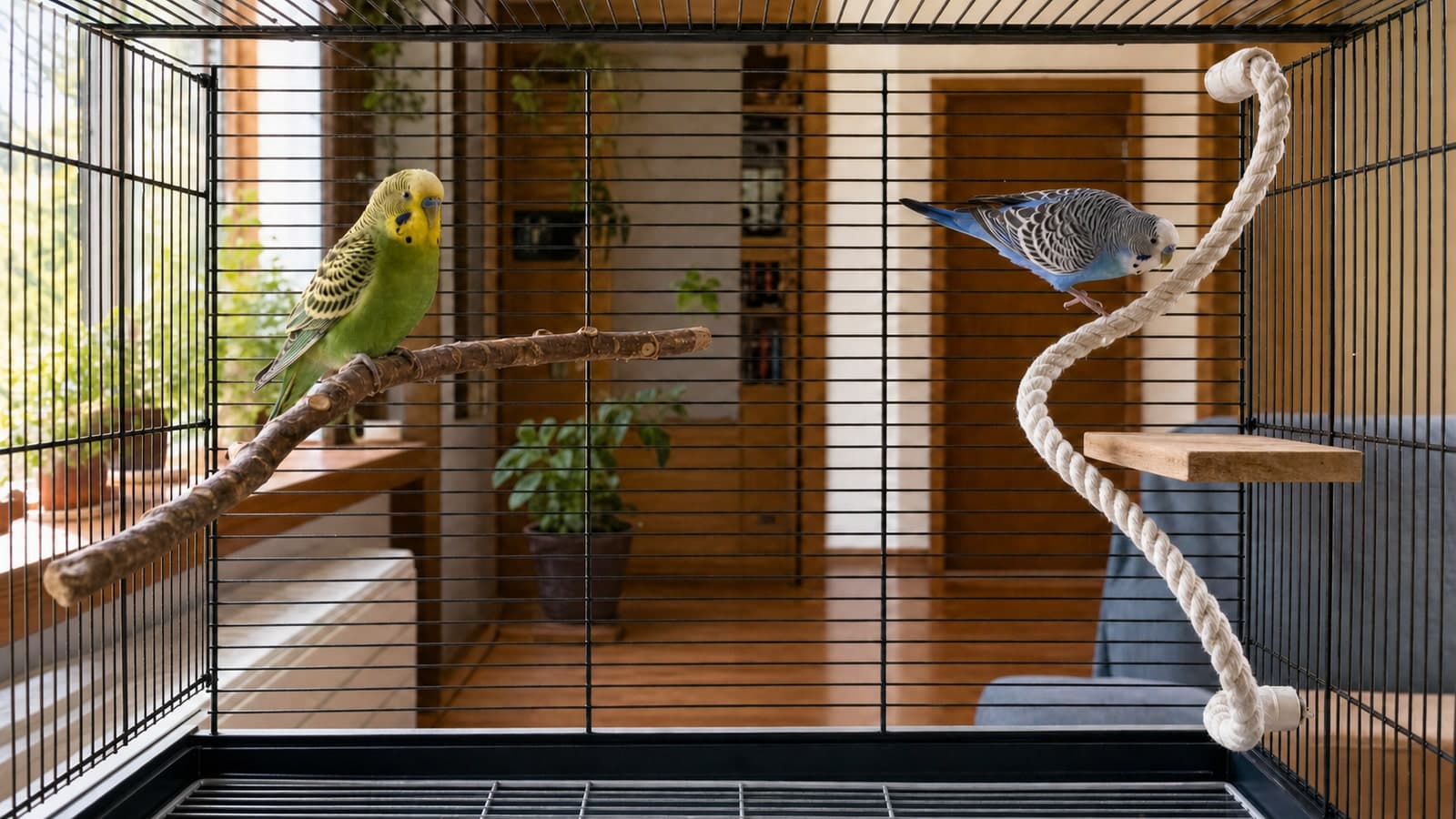
The 21-inch JW Pet Comfy Perch works as a route rather than a destination. Its flexible core can bend along a side wall, connect two levels, or create a gentle approach to a door without sending a rigid bar across the cage center. Two end mounts hold the finished shape.
Cotton rope needs a different inspection habit from wood. Chewy's current care instructions call for cutting loose yarn and preventing ingestion. If a budgie keeps pulling fibers loose or the braid no longer stays tidy, remove the perch instead of repeatedly trimming a changing hazard.
The small Polly's Comfy Clam adds the only flat surface in this comparison. Its published 4.5 by 4 inch footprint is compact enough for many cage corners, and the bolt mount can orient the piece horizontally or vertically. Use it as a small resting ledge, not as a replacement for varied branch diameters.
That footprint still uses more interior area than a narrow perch. Mount it where the bird can approach without squeezing past a toy or dish, and where droppings do not land in food or water. The composite surface is consumable, so replace the perch when wear, chipping, or a damaged mount changes it.
Place them in this order
- Set the natural branch. Put one useful landing near a door or daily-care station without blocking access.
- Mark the open route. Look from one end of the cage to the other and keep the central movement line clear.
- Add a side path if it helps. Curve the rope along a wall instead of across the middle.
- Add a flat rest only if the corner is truly open. Keep the ledge away from bowls and the busiest flight line.
- Move the extras before moving the foundation. If a toy crowds the route, relocate the toy rather than filling every remaining gap.
Keep daily standing surfaces comfortable and inspectable
One perch should not force the feet into the same grip all day. Natural diameter changes, a different route shape, and an occasional flat rest can create variety without abrasive surfaces. Sandpaper and similar rough covers are not a substitute for a thoughtful perch map.
Check the branch for splinters and deep chewing. Check the rope for loose yarn, open loops, and a changing mount. Check the flat rest for chips, wear, and hardware that no longer sits firmly against the bars. Also look below every perch: a good landing should not turn the food or water station into a drop zone.
The one-minute cage check
- The branch is firm and its free end has clearance.
- The rope braid is tidy, with no loose loop or exposed wire.
- The ledge and every bolt sit flat against the cage bars.
- No surface hangs above food or water.
- The door opens fully.
- The central route still looks like open air.
Use the budgie cage setup guide to map the complete flight home, then place the three perch roles or compare them side by side. The current budgie supply shelf is the wider browse once you know the role, fit, and placement you need.