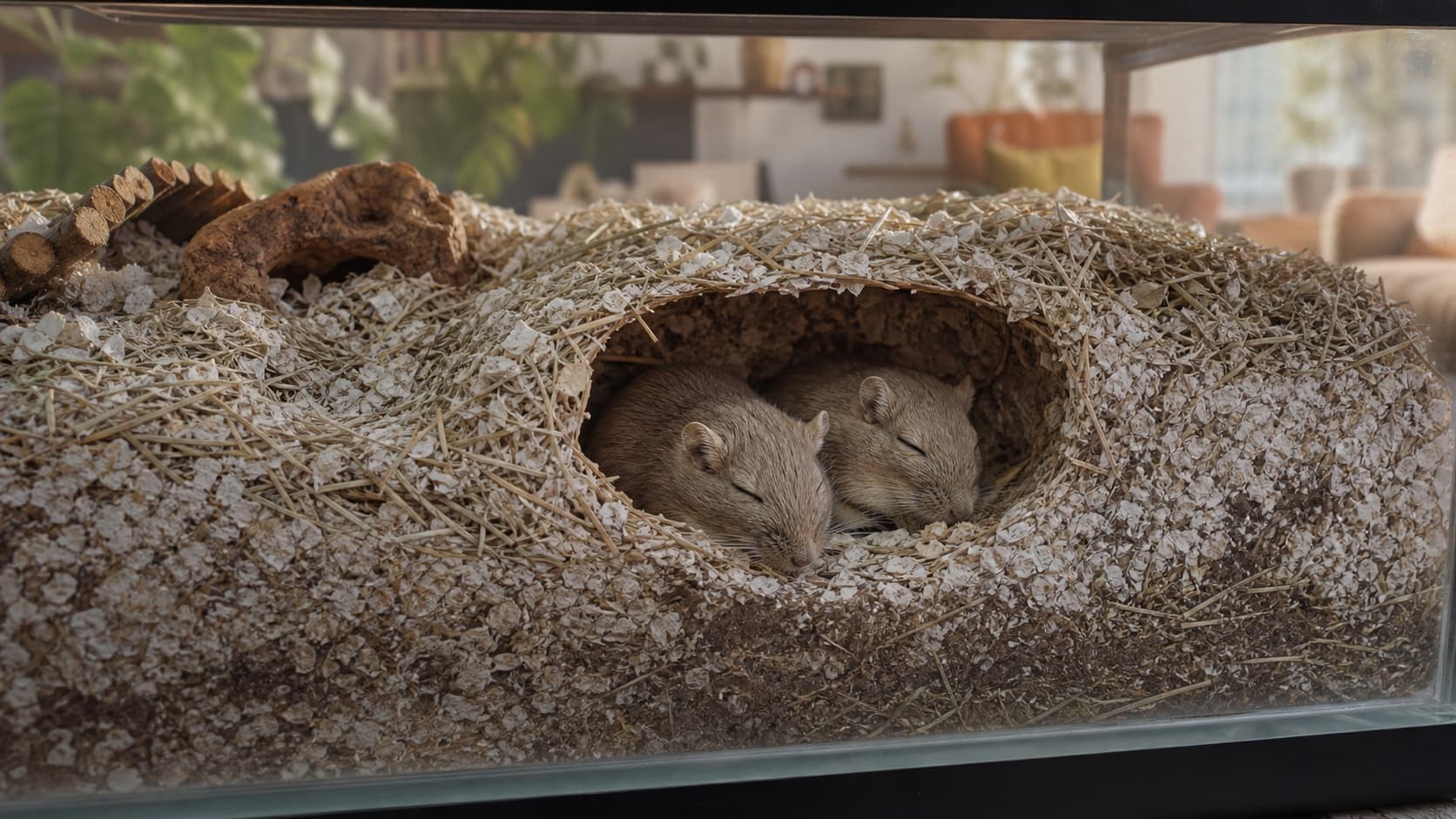
Gerbils need compatible company of their own kind. A bonded same-sex pair can sleep, groom, forage, dig, explore, and communicate together throughout the day and night. Human attention adds to that life but cannot replace another gerbil.
The Blue Cross gerbil care guide states that gerbils are very sociable and should not live alone. The Blue Cross small-pet guide similarly describes pairs or small groups as the appropriate social arrangement.
Begin with an established bond
The simplest starting point is a same-sex pair of littermates or an already bonded pair from a rescue. Ask for the pair's social history, sex confirmation, approximate age, ordinary food, and current setup.
Bring the pair home together and place them into one complete territory. Provide enough food, water access, floor space, bedding, and routes for both animals while maintaining one connected shared home.
Let the shared nest stay shared
Gerbils commonly sleep together, and that shared nest helps maintain the social bond. Blue Cross recommends one nest area rather than several competing sleeping territories. The nest should have room for both animals and more than one entrance.
Deep substrate gives the pair the freedom to build their own connected chambers. Plain cardboard and shredded paper can be moved and reshaped as the pair works.
Distribute resources without dividing the home
Spread food across several foraging points and make water easy for both animals to reach. Keep the wheel, sand bath, tunnels, and surface routes accessible without narrow dead ends.
The aim is choice within one connected territory:
- Several ways through the surface layout.
- Enough open space for both animals to move.
- A large shared nest with multiple entrances.
- Food scattered across more than one area.
- Water checked daily and positioned away from bottlenecks.
- Cardboard, hay, and bedding available for shared building work.
Learn the pair's ordinary signals
Bonded gerbils may sleep together, groom one another, investigate side by side, swap places in tunnels, and use the same food cache. Brief chasing or squeaking can occur during ordinary communication, but the pattern and intensity matter.
Watch for a gerbil repeatedly excluded from the nest, food, water, or surface; persistent hard chasing; a tight ball fight; biting; injury; or a sudden collapse of the shared sleeping pattern. Separate animals safely with a solid barrier or carrier when immediate injury is possible, and contact a veterinarian or experienced gerbil rescue promptly.
Avoid reaching into an active fight with bare hands. A rigid board, container, or thick towel can help create separation without placing fingers between the animals.
Keep change measured
Large scent and layout changes can unsettle a territory. Preserve some clean, dry familiar bedding during fuller cleaning and keep core water, nest, and equipment positions understandable. Add new objects one at a time and watch how both gerbils use them.
If one member of a pair dies, the surviving gerbil's next social plan depends on age, history, health, and temperament. A gerbil-experienced rescue or veterinarian can help assess whether and how a new introduction should proceed.