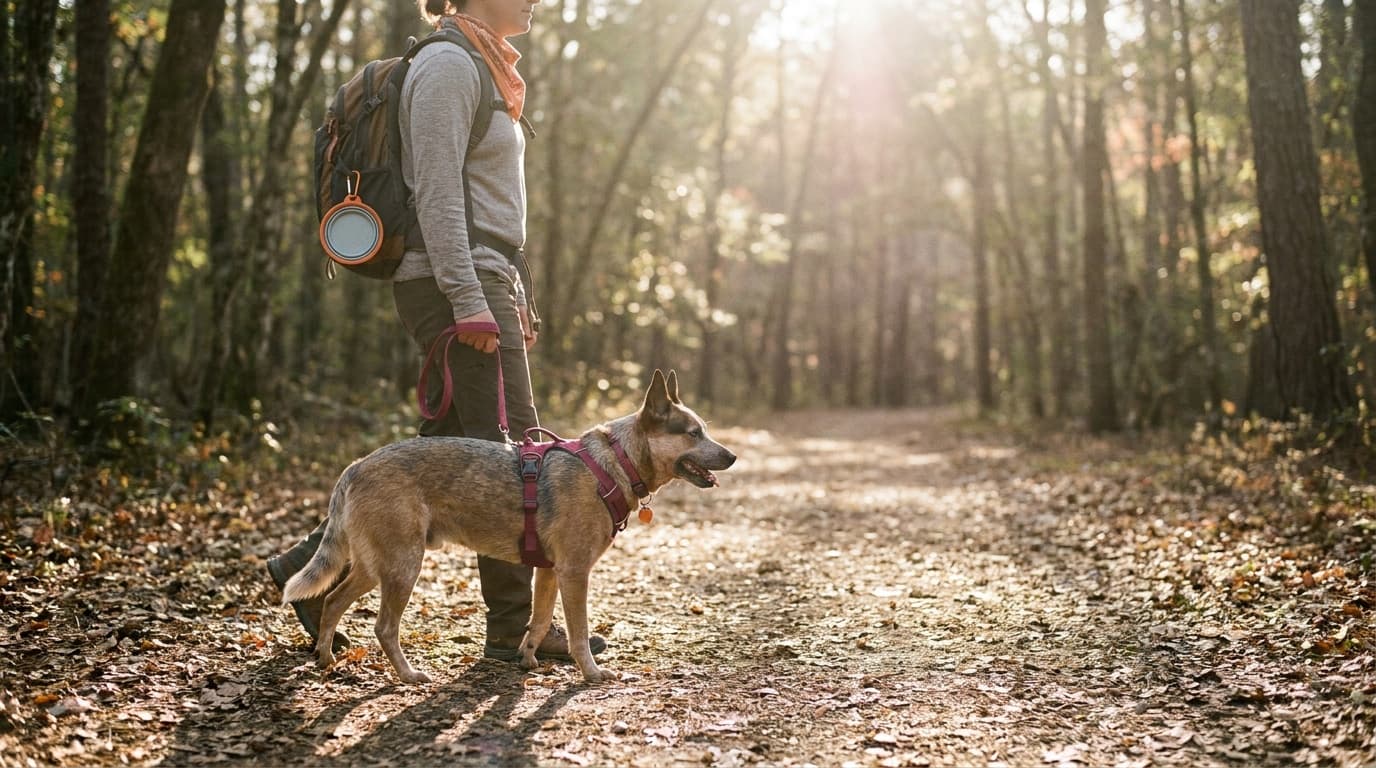
Hiking with a dog works best when you treat your dog like a training partner, not a passenger: build fitness gradually, pick trails that allow dogs, keep the leash on, and plan for water, heat, and paws before you need to. The American Kennel Club recommends conditioning a dog for the trail the same way you would condition yourself, starting with shorter, easier outings and adding distance and elevation over weeks. Get those fundamentals right and most hikes are exactly what you hoped for: tired dog, good day.
Start with a vet check and honest fitness
Before planning a long trail day, confirm your dog is ready for it. A quick conversation with your veterinarian covers the things you cannot see from the outside: joint health, heart and breathing capacity, weight, and whether your dog's age fits the plan. Puppies are still growing, and the AKC advises keeping outings short and easy until a young dog matures, since long, strenuous miles are hard on developing joints. Seniors, flat-faced breeds, and overweight dogs need shorter, cooler, flatter routes.
Ask your vet about parasite and vaccine coverage for the terrain too. Trails mean ticks, standing water, and wildlife. The AKC notes that leptospirosis spreads through water and soil contaminated by wildlife urine, which is exactly what puddles and slow creeks on a trail can be, so flag trail plans at your next visit and keep flea, tick, and heartworm prevention current.
Then build fitness the boring way: start with brisk neighborhood walks, move to short local trails, and add distance gradually while you watch how your dog recovers the next day. If you want to build your own carrying fitness at the same time, our sister site Ruck Authority's guide to rucking with your dog covers weighted walking for the human half of the team, including how to pace the program around the dog.
Pick the trail and follow the leash rules
Not every trail welcomes dogs, and the rules vary more than most owners expect. Many national park trails restrict dogs entirely, while national forests, state parks, and local trail systems are often more permissive. Check the managing agency's current rules before you drive out, and have a backup trail in mind. Many national forests and state lands are also open to hunting in the fall, so during those seasons put a bright orange vest on your dog and wear orange yourself. Our sister site Sportsman Authority compares high-visibility dog vests by fit, terrain, and temperature.
Where dogs are allowed, a leash is almost always required, commonly a 6-foot maximum. The AKC recommends a short leash on the trail for safety, courtesy, and control: it keeps your dog out of wildlife, poisonous plants, and other hikers' space, and it keeps a startled dog from bolting over an edge or into brush. A standard flat leash clipped to a well-fitted harness gives you more control on uneven ground than a collar alone; our guide to the best dog harnesses covers fit. Skip retractable leashes on trails, since they teach pulling and offer little control at distance.
For the first few outings, choose routes below your dog's ability: shorter than your usual walk mileage, modest elevation, shade, and water access. You are testing recovery, paw toughness, and trail manners, not setting records.
Dog packs and how much weight a dog can carry
A dog pack lets your dog carry its own water and kibble, but load it like you would load a new hiker: lightly, and only after conditioning. The AKC notes that young, healthy dogs can work up to roughly 25 percent of their body weight in a properly fitted pack, with some breeds comfortable with more and others, especially small or short-nosed breeds, suited to far less or none at all. Treat that figure as a ceiling for a conditioned dog, not a starting point.
A sensible progression looks like this:
- Ask your vet first. Age, joints, breed, and body condition decide whether a pack makes sense at all.
- Fit the pack empty. Snug behind the shoulders, weight over the front half of the body, no rubbing at the armpits. Let your dog wear it around the house and on walks before it carries anything.
- Start near 10 percent of body weight once your dog moves normally in the empty pack, and add weight over weeks, keeping both sides balanced.
- Watch the dog, not the number. Lagging, panting harder than the terrain explains, sitting down, or a changed gait means unload the pack.
Water and heat management
Plan your dog's water the way you plan your own, then add margin. Dogs cool themselves mostly by panting, which costs water quickly on a warm climb. Offer water at every break rather than waiting for signs of thirst, and bring a collapsible bowl or a bottle with a built-in cup. Discourage drinking from puddles, ponds, and slow streams, since they can carry giardia and the bacteria behind leptospirosis. For working out how much total water to haul for the human side of the equation, our sister site Kit Authority's guide to how much water to bring hiking has a practical planning method; carry your dog's share on top of that.
Heat is the trail risk that turns serious fastest. The ASPCA advises limiting exercise on hot days to early morning and evening, watching closely for heavy panting, glazed eyes, weakness, stumbling, or deep red or purple gums, and moving a symptomatic animal to shade and calling a veterinarian. Humid days are worse than the thermometer suggests because panting works poorly in humid air.
Paw care on rock, heat, and ice
Pads toughen with conditioning, but they are still skin. The AKC warns that hot surfaces can burn pads, and the same press-your-hand test works on rock as on pavement: if you cannot hold your palm on it comfortably, it is too hot for bare paws. Check pads at breaks for cuts, thorns, and wear, and trim nails before hikes so they do not catch on rock. For sharp scree, hot slickrock, or snow and ice, conditioned boots help; see our guide to the best dog boots for fit and break-in, since a boot that rubs is worse than no boot.
After the hike, rinse or wipe paws, recheck between the toes for grass seeds and ticks, and do a full-body tick check while your dog is tired and cooperative. Our guide to checking your dog for ticks covers the spots owners miss.
Trail etiquette with a dog
Good etiquette keeps trails open to dogs. The core of it:
- Keep the leash on, even if your dog is friendly and even if the trail is empty. Wildlife, other dogs, and hikers who fear dogs all share the space.
- Yield the trail. Step aside with your dog on the outside for horses, uphill hikers, and anyone who looks uncertain, and put yourself between your dog and passing traffic.
- Ask before greetings. Never let your dog approach another dog or person without an invitation; the other dog may be reactive, in training, or recovering from an injury.
- Pack out waste. Bag it and carry it out. Bagged waste left trailside for "later" is the single most cited complaint against trail dogs.
- Keep barking in check. A dog that cannot settle around passing hikers needs more practice on quieter routes first.
Gear checklist for a dog-friendly day hike
- Well-fitted harness and a standard 6-foot leash
- Water for the dog plus a collapsible bowl
- Dog food or high-value treats, sealed against weather and wildlife interest
- Waste bags, enough to carry out everything
- Paw protection appropriate to the terrain, broken in beforehand
- A compact pet first aid kit; our pet first aid kit checklist covers the contents
- ID tag on the collar and current microchip registration
- Towel and fresh water in the car for cleanup and the ride home
- Optional: fitted dog pack, loaded per the progression above
The bottom line
A great trail dog is built, not found: vet clearance, gradual conditioning, a short leash, planned water, and honest attention to heat and paws. Start below your dog's limits and the limits will move. If your dog is new to structured outings, our guides to essential commands to teach your dog and how to travel with a dog make the drive to the trailhead and the manners on it a lot easier.