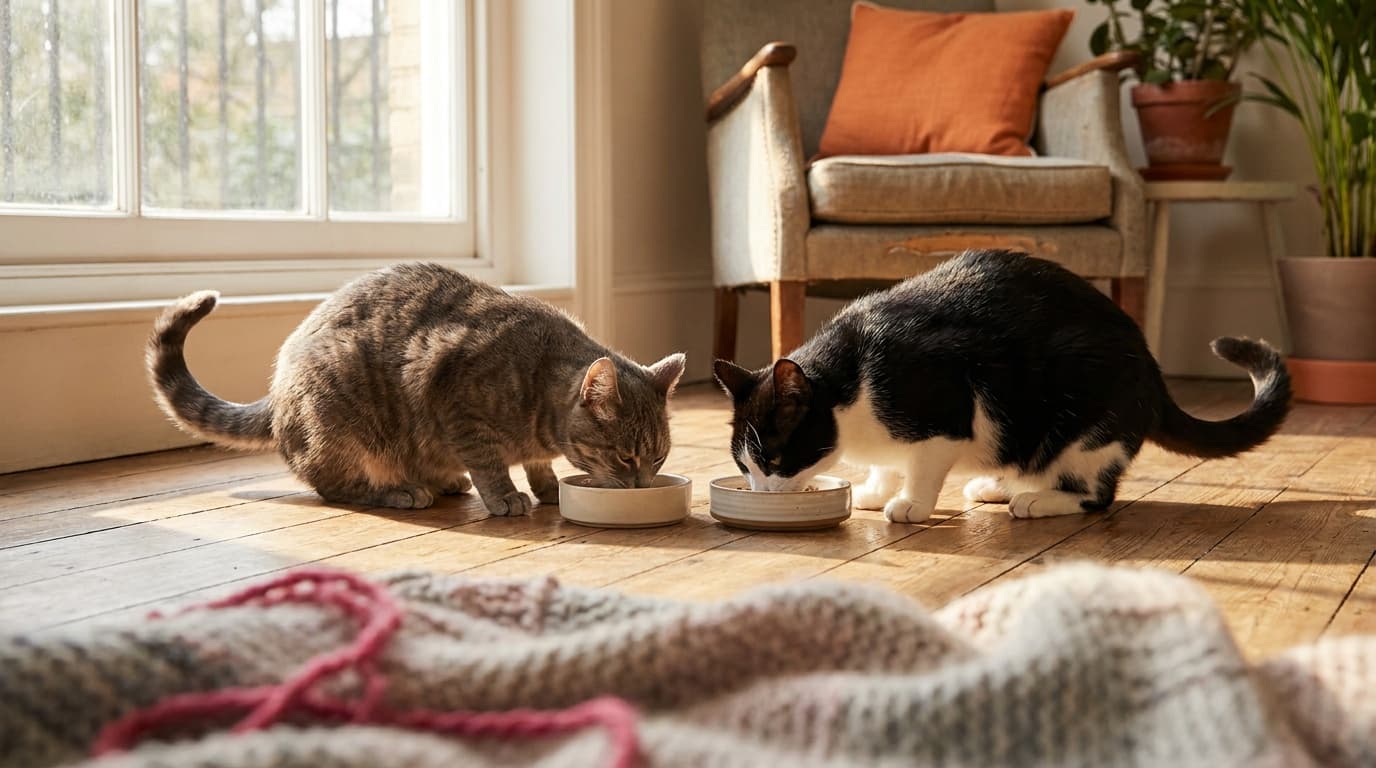
Cats are not naturally communal eaters. In the wild they hunt and eat alone, so crowding several cats around a shared bowl can create quiet stress, uneven portions, and a real difficulty knowing who is eating what. A few adjustments fix most of it. VCA Animal Hospitals recommends feeding cats in separate locations and monitoring meals rather than leaving one big bowl out for everyone, and that idea shapes the whole approach below.
Separate bowls in separate places
The most useful habit in a multi-cat home is giving each cat its own bowl, ideally in its own spot. VCA suggests feeding cats in separate locations, for example one cat in one room and another elsewhere, so each can eat without feeling watched or crowded. Simply lining up bowls side by side is not the same thing: cats prefer some distance, and a nervous cat pressed next to a bolder housemate may hurry, walk away, or skip the meal entirely.
A widely used guideline borrowed from litter box advice applies here too: think one resource per cat, plus one spare, spread around the home. For food and water that means enough separate stations that no cat has to compete or wait its turn. Spacing bowls out, and adding vertical options like a perch or counter for a cat that likes to eat up high, lets a multi-cat household eat in parallel instead of in a scrum.
Monitor who eats what
When several cats share food freely, you lose the single most useful health signal a cat gives you: its appetite. A cat that goes off its food is one of the earliest hints that something may be wrong, and in a shared-bowl home that dip is invisible because a housemate eats the difference. Feeding cats separately, and watching meals, lets you notice quickly if one cat is eating less, eating more, or not showing up at all.
VCA recommends offering meals at set times and removing uneaten food after a defined window rather than leaving it out indefinitely. Portioned, monitored meals also let you feed each cat the right amount, which matters because cats in the same home often have different needs. A young, active cat and an older, sedentary one should not be eating from the same endless bowl. If you notice a cat eating noticeably less or more than usual, drinking more, or losing or gaining weight over a few weeks, that is a reason to call your veterinarian rather than something to sort out by rearranging bowls.
The trouble with free-feeding and shared weight problems
Leaving dry food out all day, known as free-feeding, is convenient but carries a specific risk in multi-cat homes: you cannot control or even measure how much any one cat eats. VCA's general feeding guidelines for cats note that portioned meal feeding gives far better control than free access to a communal bowl. When food is always available, it is easy for one or more cats to drift into being overweight without anyone noticing until it shows.
That matters because excess weight is one of the most common and preventable feline health problems. The American Animal Hospital Association recommends assessing each pet's body condition regularly, since a cat can slowly gain weight while its housemates stay lean on the same shared bowl. Measured, separated meals make it possible to keep each cat at a healthy weight instead of managing the household as one undifferentiated group.
When to loop in your vet
Most multi-cat feeding challenges are solved with separation, set meals, and a little spacing. Some need more. If one cat consistently blocks another from eating, if a cat is steadily gaining or losing weight, or if one needs a prescription or therapeutic diet the others should not eat, that is worth a conversation with your veterinarian. They can confirm each cat's ideal body condition, recommend how to keep diets separate, and rule out a medical reason behind an appetite change. These are assessments to make with a professional rather than guesses to make at home.
The bottom line
Feeding multiple cats well comes down to respecting that cats prefer to eat alone: separate bowls in separate places, enough stations that nobody competes, set meals instead of a bottomless bowl, and a daily eye on who is eating what. That structure keeps portions right, catches early signs of illness, and prevents the slow weight gain that free-feeding encourages. When something seems off with a cat's appetite or weight, bring in your vet. For portioning each cat, see our guide to how much to feed your cat.