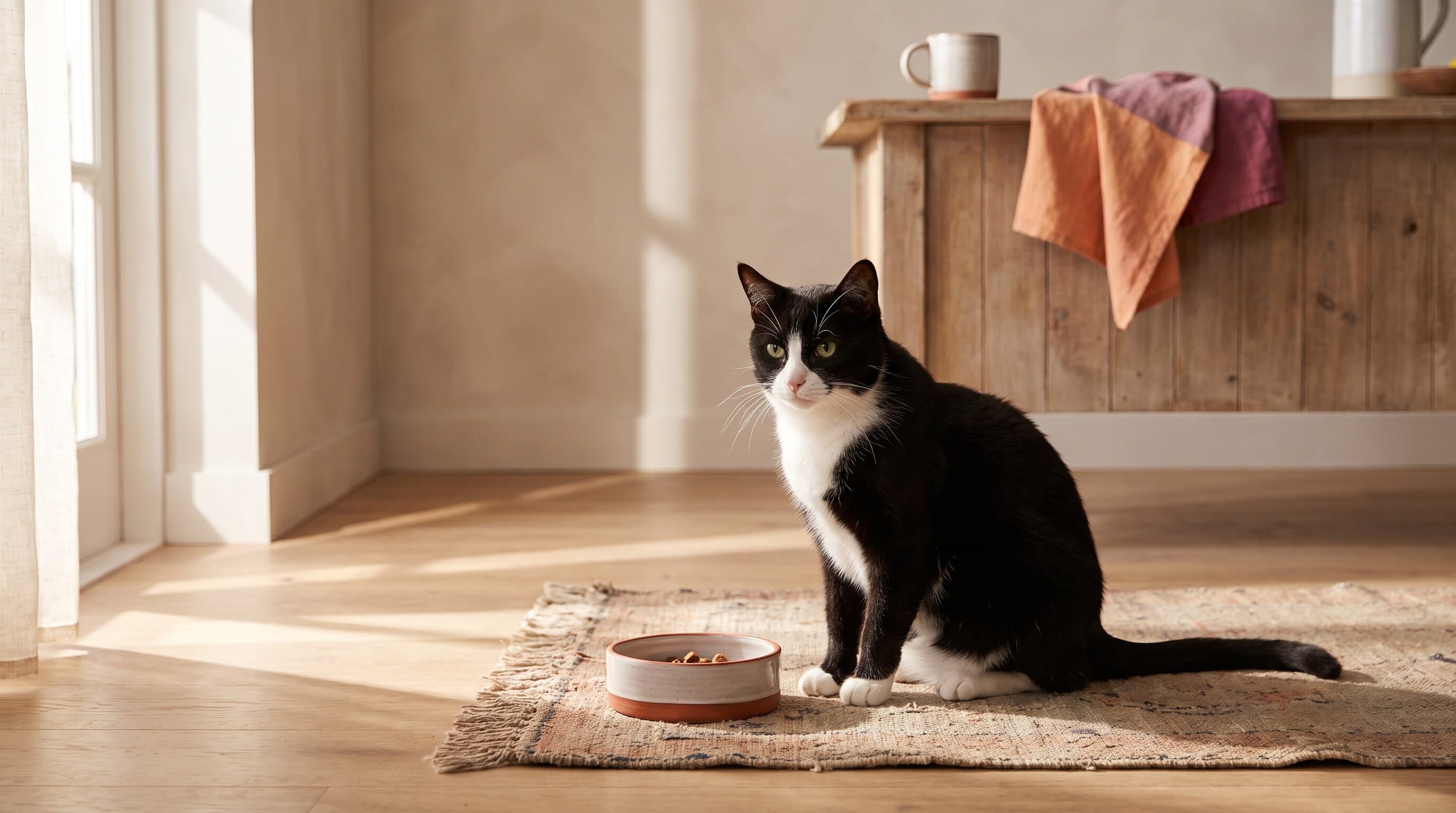
Cats make this question harder than it looks, because a cat's calorie needs are small and easy to overshoot. A few extra treats or a bowl left full all day adds up quickly on a 10-pound animal. According to the Cornell Feline Health Center, obesity is the most common nutrition-related problem in cats, and it raises the risk of conditions like arthritis and diabetes. The best amount to feed is the amount that keeps your individual cat at a lean, healthy body condition, and that usually takes some adjusting.
Start with the label, verify with the cat
Like dog food, commercial cat food carries a feeding guide based on body weight, and it is a starting point rather than a final answer. VCA Animal Hospitals recommends letting your veterinarian help set the portion, because the right amount depends on your cat's life stage, whether they are spayed or neutered, their activity level, and their current body condition. A neutered indoor adult cat, which describes most house cats, needs meaningfully fewer calories than the average listed on a can or bag.
The practical method is the same as for dogs: measure the portion, feed it consistently, then check your cat's body over a few weeks and adjust. You should be able to feel the ribs under a light layer of fat and see a slight waist when looking down from above. A rounded belly that sways when your cat walks, or ribs you cannot find, points to extra weight.
Wet versus dry, and how to portion each
Both wet and dry complete-and-balanced foods can meet a cat's needs, and many owners feed a combination. The main portioning difference is calorie density. Dry food is concentrated, so a small volume carries a lot of calories, which makes over-serving easy. Canned food is mostly water, so a larger-looking portion may contain fewer calories and also contributes to a cat's daily water intake, something cats are not always good at getting on their own.
Because the two differ so much by volume, do not assume a scoop of one equals a scoop of the other. Read the calories-per-serving figure on each product, which is required on the label, and portion to a daily calorie target rather than to a fixed cup or can count. If you are moving between food types or brands, transition gradually to avoid stomach upset.
Free-feeding versus scheduled meals
Free-feeding, leaving dry food available all day, is convenient but makes it hard to track how much a cat actually eats and easy for a food-motivated cat to overeat. Scheduled meals, one or two measured servings a day, give you far more control over portions and let you notice quickly if your cat's appetite changes. Cornell's guidance on feeding frequency notes that for most healthy adult cats, feeding once or twice a day is appropriate.
There is no single correct schedule for every household. Some cats do well with small, frequent meals from a portioned automatic feeder, which can mimic a cat's natural pattern of many small "hunts" a day while still capping the total. What matters most is that the daily total is measured and appropriate, however you choose to divide it. In multi-cat homes, scheduled or separated feeding also stops a bolder cat from eating a shyer cat's share.
When to involve your veterinarian
Reach out to your veterinary team if your cat is a kitten, is pregnant or nursing, is overweight or underweight, or has a health condition such as kidney disease, diabetes, or hyperthyroidism, all of which change how much and what a cat should eat. VCA's guidance on feline obesity stresses that weight loss in cats should be done carefully and slowly under veterinary supervision, not by simply cutting the current food, because crash dieting a cat can be dangerous.
Your veterinarian can calculate a specific daily calorie target for your cat and recommend a feeding plan built around it. That individualized number is always more accurate than a printed range. For the dog-owner version of this question, see how much should I feed my dog.