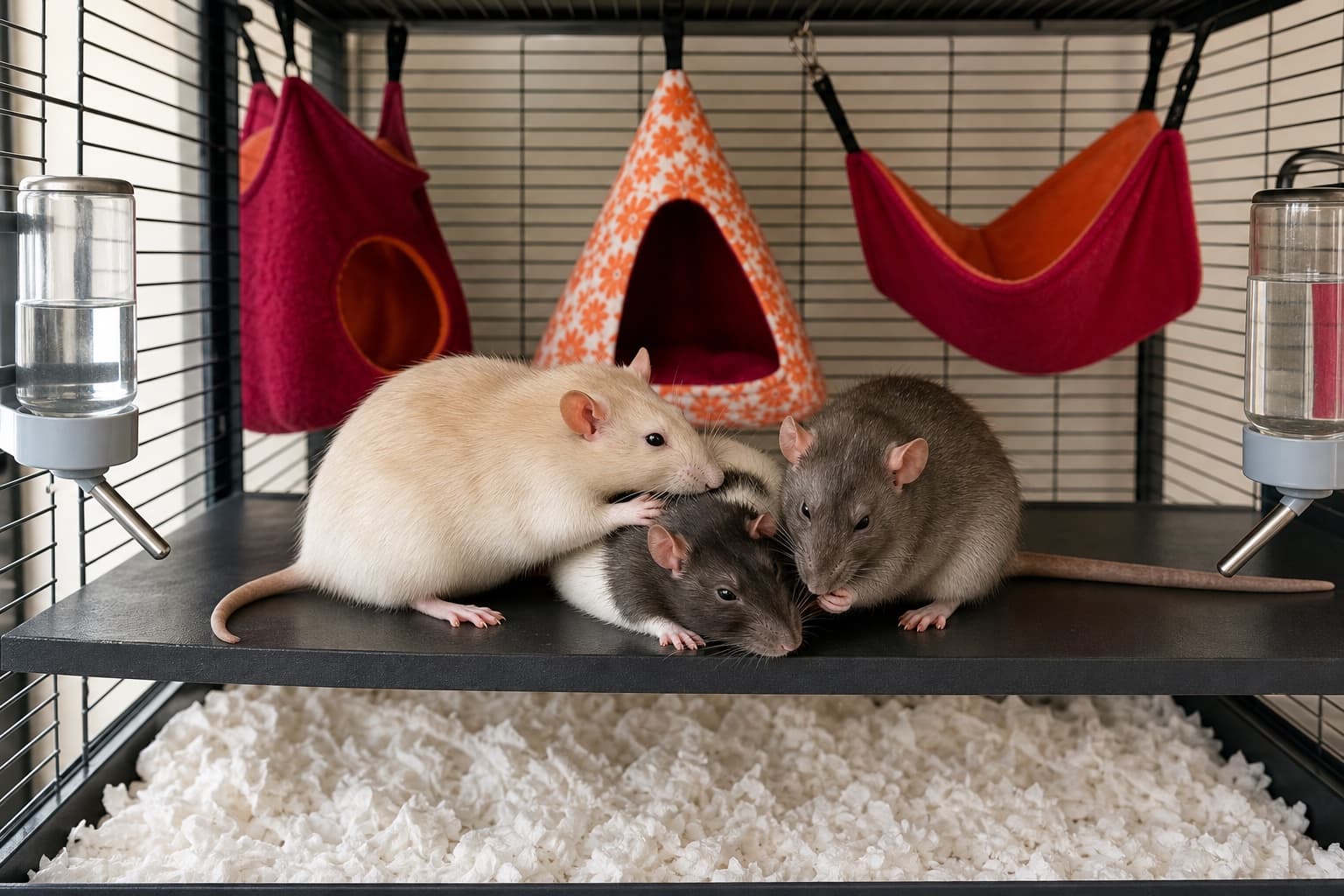
Pet rats need compatible rat company. A person can provide attention, training, and supervised exploration, but cannot replace the grooming, sleeping, play, communication, and constant social choices rats share with one another.
The RSPCA company guide recommends keeping rats in compatible same-sex pairs or groups and explains that isolation can undermine welfare. Blue Cross likewise advises keeping at least a pair.
Begin with an established pair or group
The simplest starting point is a bonded same-sex pair or compatible group from a rescue or responsible breeder. Ask how long the rats have lived together, whether the sex of each rat has been confirmed, and whether the group has a known introduction or conflict history.
Bring the bonded group home together. Prepare enough room and resources for every rat before arrival. A small carrier may be suitable for a short journey, but the permanent cage needs several resting places, water points, and routes.
Give the group meaningful choice
Good social housing does not mean forcing constant contact. Rats need places to sleep together and places to step away. Several hammocks, covered hides, broad shelves, and connected routes let individuals choose proximity.
Distribute high-value resources:
- More than one water point.
- Several covered sleeping places.
- Food presented across multiple locations.
- More than one route between important levels.
- Several enrichment objects that do not create a single bottleneck.
Watch whether every rat can reach food, water, cover, and resting space without being repeatedly blocked.
Understand ordinary group behavior
Compatible rats may groom one another, sleep in a pile, follow each other, play, squeak briefly, or negotiate access to a favorite spot. One moment should be read in context with the whole pattern.
Notice whether the group returns to ordinary resting and exploration, whether each rat can use essential resources, and whether anyone is persistently excluded. Regular observation is more useful than interrupting every lively interaction.
Injury, sustained pursuit, repeated cornering, or a rat unable to reach essential resources needs prompt experienced help. Contact a veterinarian for any injury or marked change in behavior, and ask a reputable rat rescue or experienced welfare professional for introduction support.
Plan introductions carefully
Do not place an unfamiliar rat directly into an established cage. Resident scent and limited space can make that meeting harder. Introductions are a process using neutral territory, appropriate pacing, close observation, and a clean, rearranged home when the group is ready.
The correct pace depends on age, sex, reproductive status, health, and prior social experience. A rescue that regularly forms rat groups can help plan the sequence and recognize when to pause.
Prepare for changes in the group
A pair can become a single rat after a loss. Plan before that happens by knowing which local rescue can help with companionship and introductions. The next step depends on the surviving rat's age, health, social history, and circumstances, so involve a rat-savvy veterinarian and experienced rescue rather than leaving the rat isolated by default.
The social plan also affects travel and temporary housing. Keep bonded rats together when it is safe to do so, and make sure a temporary enclosure still has enough cover, water, and room for the whole group.
Pair social life with human contact
Rats can learn names, routines, carrier transfers, and simple cues through calm repetition and positive reinforcement. Work with the group and with each rat individually. A confident rat may approach quickly while another watches before choosing contact.
Human attention adds variety to a secure rat social life. It works best when the rats can approach, leave, and return to their companions.