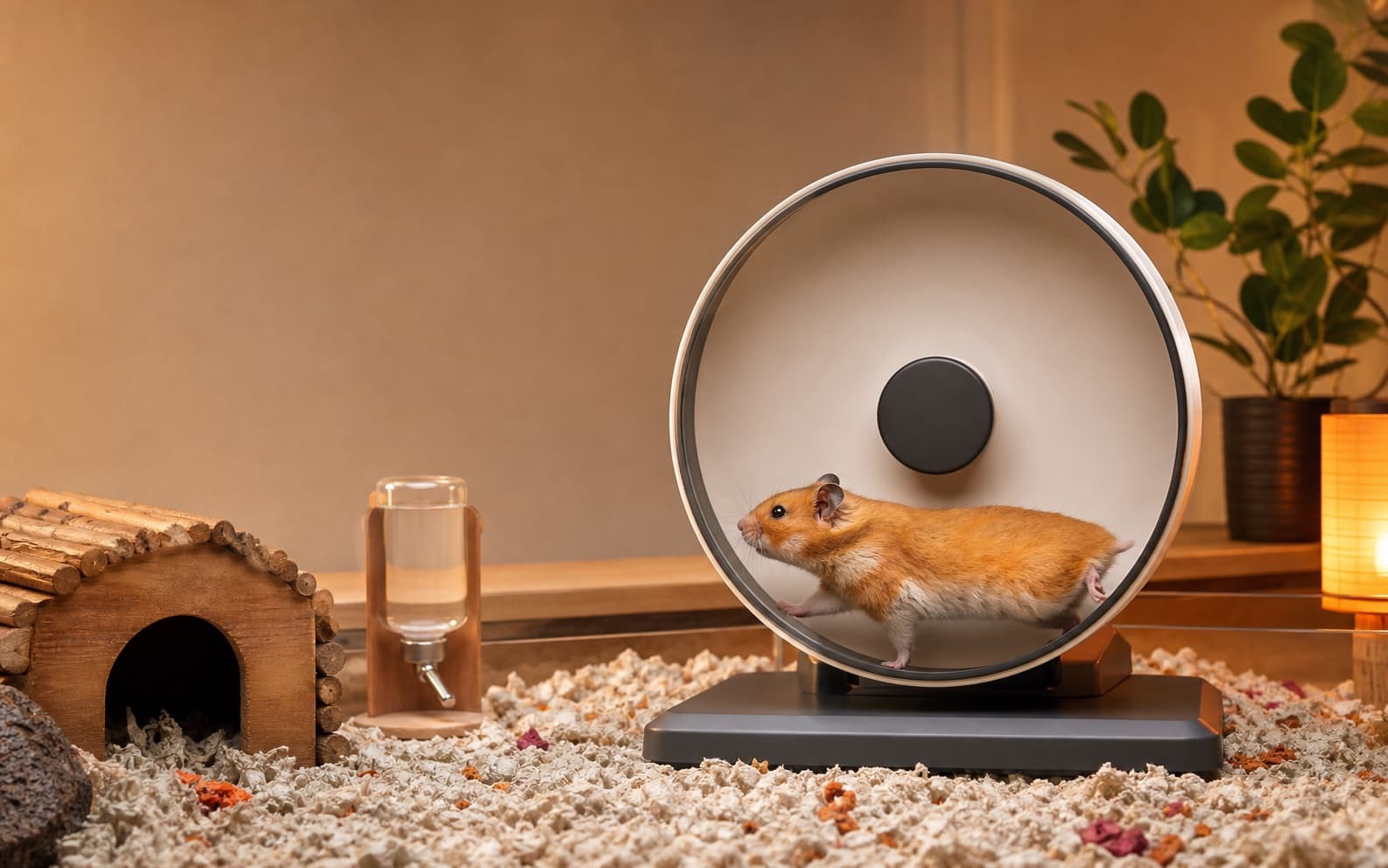
A hamster wheel should let the animal run forward with a comfortably straight back, a natural head position, and room to enter and leave without squeezing. The wheel also needs a solid running surface and a stable base that remains clear of deep bedding.
The Blue Cross hamster care guide advises choosing a wheel that does not curve the hamster's spine or force the head upward. UC Davis School of Veterinary Medicine notes that hamsters may use the wheel frequently, making fit and construction part of the everyday habitat rather than an occasional toy.
Let the hamster's posture choose the diameter
Species labels and package dimensions are only a starting point. Watch the individual hamster running from the side. The back should remain level rather than bending into a pronounced curve, and the nose should point forward instead of upward.
Syrian hamsters generally need a larger diameter than dwarf hamsters. A young animal may also outgrow an included wheel quickly. When comparing two workable sizes, the larger wheel is useful only if it still turns freely, fits the enclosure, and can be mounted securely.
Use a continuous running surface
Choose a wheel with a solid track. Open rungs and mesh can catch small feet and create an uneven running surface. Inspect seams, edges, the axle, and the rear clearance before placing the wheel in the habitat.
The hamster should be able to enter without climbing over a high lip. Long-haired Syrians need additional clearance around the axle and support so fur cannot be drawn into moving parts.
Use the Hamster Wheel Fit Lab to enter the inside habitat, finished bedding, and the complete assembled wheel's width, depth, and height. It draws side and top views, shows remaining clearance, and tests whether turning the complete wheel 90 degrees changes the fit.
Build a stable wheel zone
Place the wheel on the enclosure floor or a firm platform that reaches it. Keep deep burrowing bedding beside this zone rather than directly under an unsupported stand. A low divider or broad platform can maintain clearance while leaving the burrow area deep.
Leave an open approach and enough room for the hamster to step off without landing on a bowl, hide edge, or drop. Keep the water source close enough to find but outside the wheel's moving path.
Expect use at night
Hamsters are usually active when the household is winding down. Test wheel noise in the actual room during the evening. A smooth bearing, level base, and clearance from enclosure walls can reduce rattling.
Do not remove a well-fitted wheel simply because nighttime running is audible. Choose a more appropriate room for the complete enclosure if the activity disrupts sleep.
Check fit and condition regularly
Watch the hamster use the wheel from the side when possible. Recheck stability after spot cleaning or rearranging bedding. Wipe the running surface as needed and inspect the stand, axle, and attachment points for wear.
A sudden stop in wheel use can reflect a blocked or unstable wheel, a changed layout, or a change in the hamster's condition. Check the equipment first, then look at eating, drinking, movement, posture, and the rest of the normal evening routine. A marked behavior change with other concerning signs warrants veterinary advice.
The best wheel is the one that disappears into the hamster's routine: stable, roomy, quiet enough for the room, and available every active night.