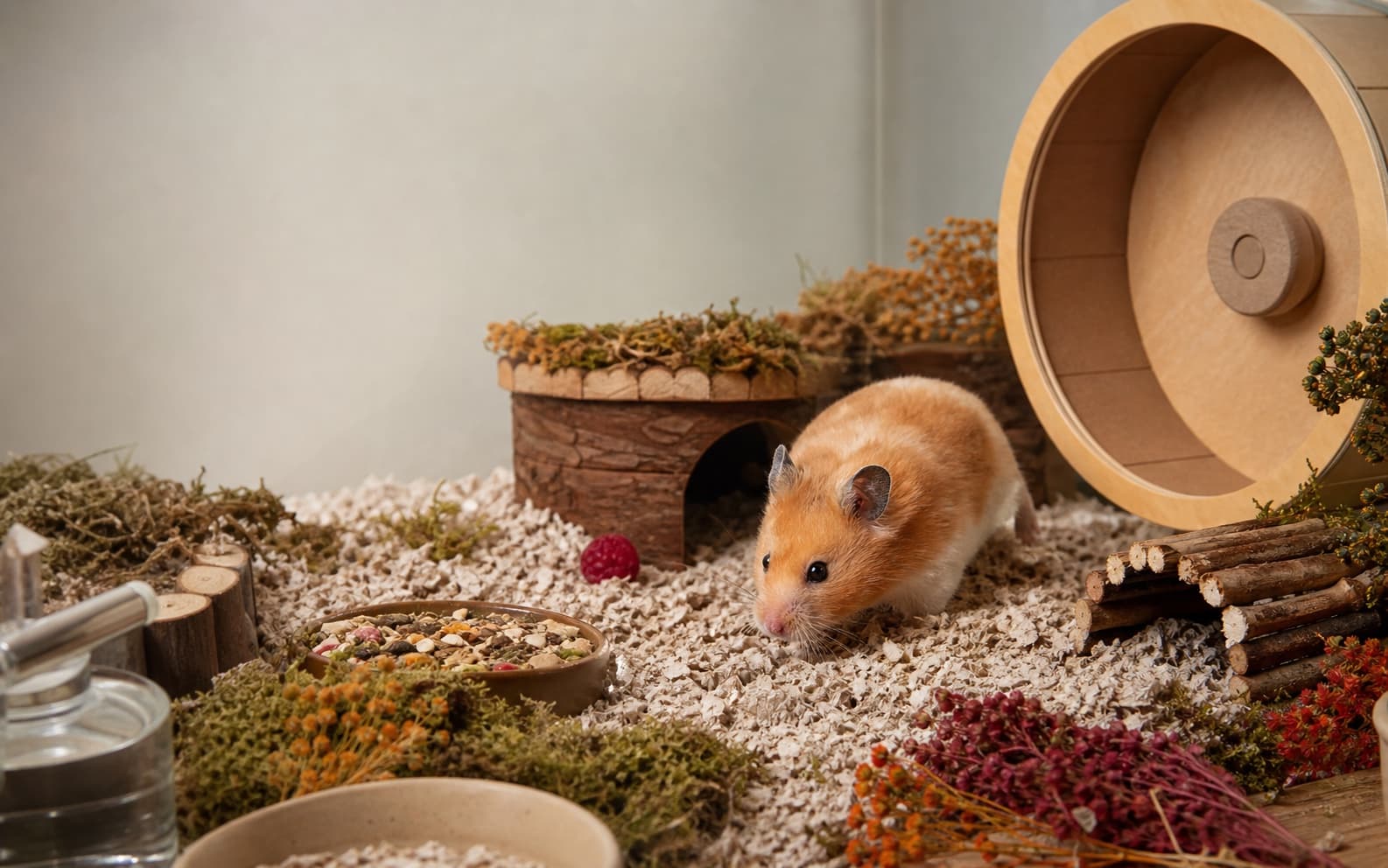
Plan a pet hamster's long-term care around one hamster in one complete enclosure. Syrian and Chinese hamsters are solitary and should live alone. Some welfare guidance describes limited circumstances in which certain dwarf hamsters have lived in established same-sex groups, but those animals do not need company and a previously stable group can still break down.
The Blue Cross hamster care guide states that most hamster species are naturally solitary and may fight when kept together. The RSPCA company guidance specifically identifies Syrian and Chinese hamsters as animals that live alone and notes that even eligible dwarf groups need careful monitoring and separate housing if relationships fail.
Syrian and Chinese hamsters need individual homes
An enclosure is a confined territory with no safe option to travel far away from a conflict. Syrian and Chinese hamsters therefore need their own secure habitat, wheel, nest, water, food, and enrichment.
Two neighboring enclosures should also provide visual cover and enough separation that each animal can rest and move without constant exposure to the other's scent and activity.
Dwarf hamster groups carry ongoing risk
Species, sex, age, relationship, resources, and enclosure design all matter. A pet shop display or a litter of young hamsters is not evidence that the same animals can safely share a domestic enclosure throughout adulthood.
For a person choosing a new setup, separate individual housing is the clearest durable plan. If an established dwarf pair or group is already living together, ask an experienced hamster rescue or veterinarian about the exact species and history. Prepare a second complete enclosure before a separation becomes urgent.
Read access, not just visible fights
Conflict can appear before an obvious injury. Watch whether each animal can reach food, water, cover, and the wheel. Repeated chasing, cornering, blocking, squealing, bites, wounds, or one animal remaining hidden while the other controls the enclosure all need immediate attention.
The Blue Cross notes that hamster fights are serious and advises permanent separation after fighting. Avoid repeated reintroductions that place the animals back into the same territorial conflict.
Use a barrier, tunnel, or container to separate animals when safe to do so. Bare hands placed between fighting hamsters can be bitten. Injuries, reduced movement, reduced eating, or a marked behavior change warrant prompt veterinary care.
Replace the idea of a companion with a complete routine
A hamster living alone still needs daily care and a rich environment. Offer deep bedding, covered routes, a properly fitted wheel, forage, safe chewing material, a sand bath, and calm interaction during the animal's active hours.
Human contact should follow the hamster's comfort and schedule. It does not need to fill every hour. Much of a hamster's normal life happens underground or at night, where a secure individual territory is an asset.
One well-planned habitat is not an incomplete social life. It is the foundation for the natural territory, choices, and routine a pet hamster uses every day.