Cats can and should lose excess weight, but the single most important rule is to do it slowly and with veterinary guidance. A cat that stops eating or loses weight too fast can develop hepatic lipidosis, a serious liver condition, which makes crash dieting genuinely dangerous. According to the Cornell Feline Health Center, obesity is the most common nutritional disorder in domestic cats, and it recommends gradual, controlled weight loss rather than a sudden reduction in food.
Why crash diets are risky for cats
Cats are metabolically different from dogs and people. When a cat's calorie intake drops sharply or it stops eating, the body mobilizes fat to the liver faster than the liver can process it, and fat accumulates in the liver cells. Cornell explains that this condition, hepatic lipidosis, also called fatty liver, is most common in overweight cats that suddenly lose weight or go off their food, and it can become life threatening. Overweight cats are the ones most at risk, which is the paradox at the heart of feline weight loss: the very cats that need to slim down are the ones most endangered by doing it too aggressively.
The takeaway is not that weight loss is unsafe. It is that speed is the enemy. Slow, steady loss with a cat that keeps eating every day is safe. Skipping meals, starving a cat "to jump-start" the diet, or dropping the food ration in half overnight is not.
Start with your veterinarian
A cat weight loss plan should begin at the clinic. Your vet will confirm your cat is truly overweight using a body condition score, rule out medical causes, and calculate a safe target weight and a daily calorie amount. As the U.S. Food and Drug Administration's summary of the AAHA nutritional assessment approach explains, that assessment is the essential first step, because the right calorie target depends on your individual cat. Cornell notes that safe feline weight loss is generally slow, on the order of a small percentage of body weight per week, which is why a professionally calculated calorie target matters so much. Too aggressive a cut is the problem you are trying to avoid.
Practical steps that work
Once you have a vet-approved target, a few habits make weight loss safer and steadier.
- Measure meals precisely. Use a kitchen scale or measuring cup and feed the amount your vet set. Our guide to how much to feed your cat covers portioning.
- Split the daily ration into several small meals. Cats are natural grazers, and several small portions can feel more satisfying than one or two large ones while keeping the calorie total the same.
- Cut down on treats. Treats and table food add hidden calories. Reserve a few pieces of your cat's own measured food for rewards.
- Consider wet food. Wet cat food is lower in calorie density and higher in water, so a cat can eat a satisfying volume for fewer calories. Ask your vet whether it fits your plan.
- Ask about a therapeutic weight loss diet. These are formulated to deliver full nutrition and protein at reduced calories, which protects muscle.
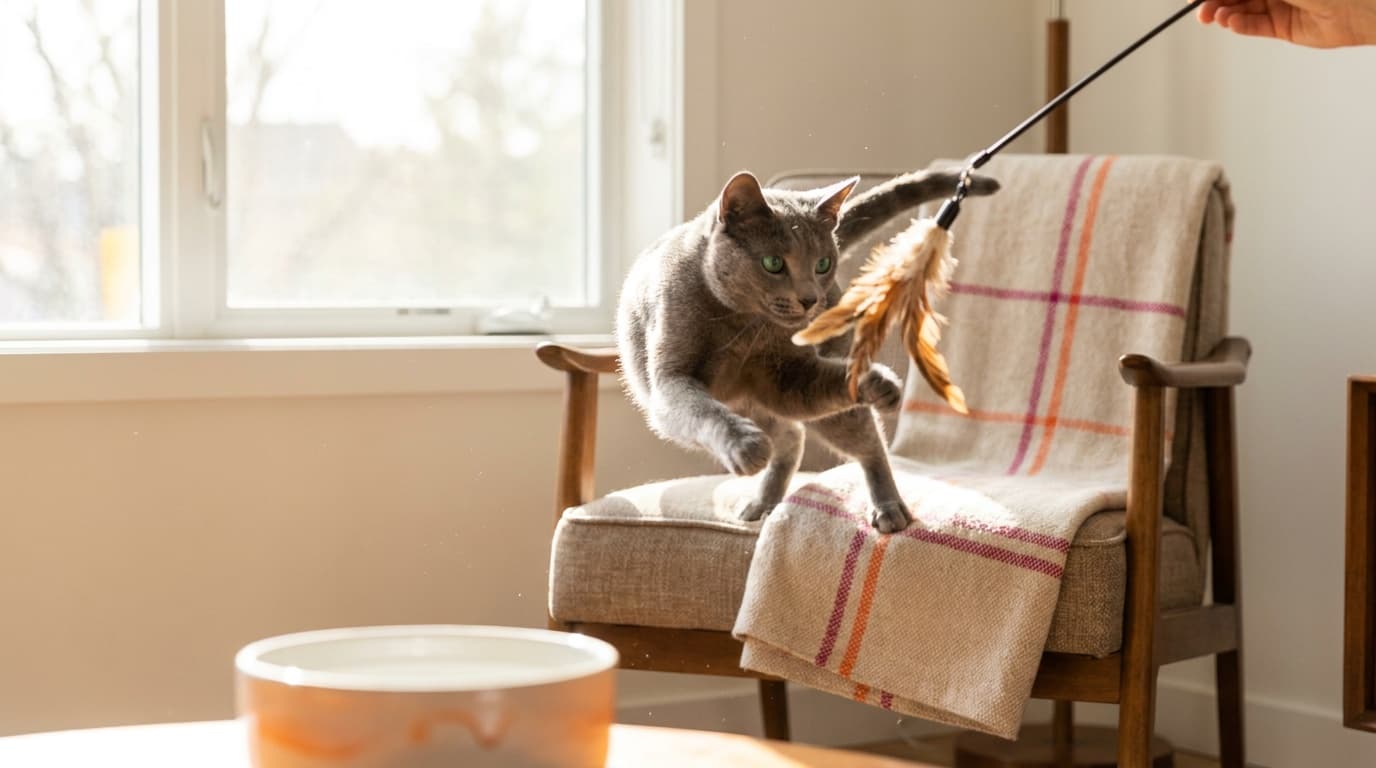
- Encourage gentle activity. Food puzzles, feeding balls, and short play sessions with a wand toy add movement without stress.
Track progress and stay in touch with your vet
Weight loss in cats is a marathon and can take many months. Regular weigh-ins, ideally at the same time of day on the same scale, let you and your vet confirm the loss is steady and adjust the plan if your cat plateaus or drops weight too quickly. Cornell's guidance frames feline weight management as an ongoing process supervised by your veterinary team rather than a fixed diet you set and forget.
Above all, watch appetite. A healthy weight loss plan is one your cat eats through happily every day. If your cat becomes lethargic, refuses food, vomits repeatedly, or develops yellowing of the eyes or gums, contact your veterinarian right away, since these can be early signs of liver trouble. Patience is not just kinder here, it is safer.