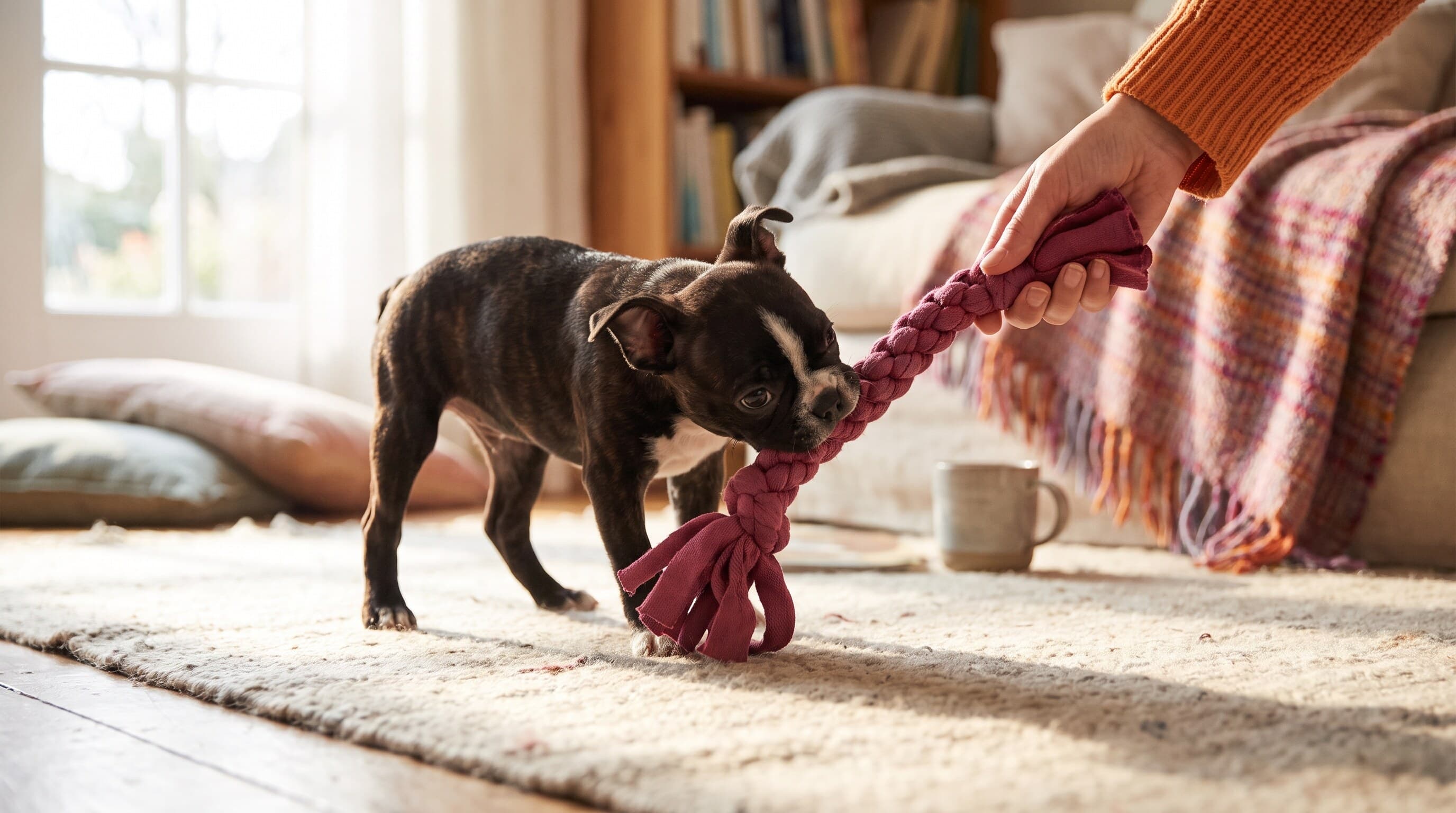
Puppy biting is normal, expected, and temporary, which is the first reassuring thing to know. Puppies explore the world with their mouths and play with their littermates using their teeth, so nipping at hands and sleeves is developmentally ordinary rather than a sign of aggression. According to the American Kennel Club, the goal is not to punish the instinct but to teach your puppy to control the pressure of their mouth and to redirect that biting onto appropriate objects. Handled with patience and positive reinforcement, most puppies grow out of it.
Understand bite inhibition first
The most important concept is bite inhibition, which means learning to use the mouth gently. Puppies normally start learning this in the litter: when one puppy bites a littermate too hard, the bitten puppy yelps and play stops, and when a puppy nurses too roughly, the mother moves away. Over many repetitions the puppy learns that hard biting ends the fun. Puppies taken home continue that education with us, which is why the techniques below all revolve around teaching soft mouths, not eliminating mouthing overnight.
Because this is a learning process, expect it to take time and repetition. The AKC frames success as gradually softening and reducing the behavior over weeks, not stopping it in a single afternoon.
What to do: redirect, pause, reward
A few consistent techniques, applied by everyone in the household the same way, do most of the work.
- Yelp and pause. When your puppy bites too hard, the AKC suggests a calm but clear "ouch" and briefly stopping play. This mimics the littermate lesson: hard mouth means the fun ends. Wait a few seconds, then re-engage.
- Redirect to a toy. Keep a chew toy within reach so you can offer it the instant those needle teeth aim for your hand or sleeve. Teaching your puppy that hands are for petting and toys are for chewing is the core substitution.
- Reward calm behavior. Positive reinforcement means catching your puppy being good. When your puppy is settled and gentle, mark it with praise or a small piece of kibble so the calm behavior gets reinforced, not just the biting.
- End the game if it escalates. If your puppy is overtired and winding up, a short break in a safe space or a nap is often the real answer, since much of the wildest biting happens when puppies are overstimulated. PetMD notes that biting often peaks around 13 weeks of age and tends to ease as adult teeth come in, so plenty of rest and appropriate chew outlets go a long way.
What not to do
Just as important as the right techniques are the ones to avoid. The AKC specifically cautions against physical punishment such as tapping the nose, holding the mouth shut, or forceful "alpha" corrections. These methods can frighten a puppy, make biting worse, and teach the puppy to be wary of hands. Yelling can backfire too: to a puppy, a big loud reaction can read as exciting attention, effectively rewarding the very behavior you want to reduce.
The theme across all of it is that biting should simply stop being productive. When a hard mouth reliably ends play and a soft mouth and calm behavior earn good things, the puppy learns the lesson without fear. Consistency from every family member matters more than any single trick, because a puppy that gets a different reaction from each person stays confused about the rules.
When to bring in a trainer
Most puppy biting fades with consistent, positive handling as the puppy matures and adult teeth come in. But some situations call for professional help. The AKC suggests consulting an experienced trainer or an animal behavior specialist if the biting has not moderated by around six months of age. Reach out sooner if the biting seems truly aggressive rather than playful, is breaking skin regularly, is directed fearfully at specific people, or simply is not improving despite your consistent efforts.
Look for a trainer who uses positive-reinforcement, reward-based methods, in line with the approach above. For more on setting up good habits from day one, see our new puppy checklist for the first week, and for another cornerstone of early training, our guide to crate training a puppy.