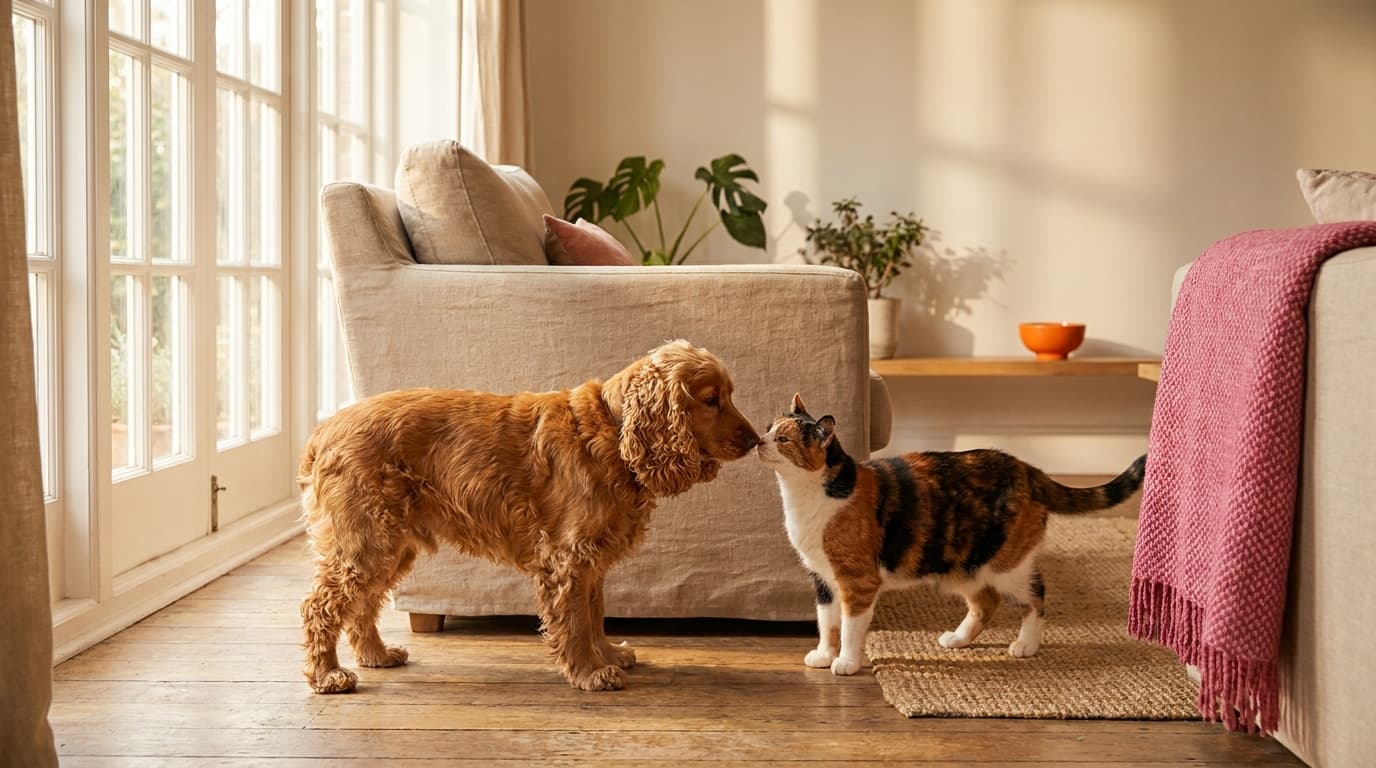
A second pet can be wonderful, but it is not automatically good for the pet you already have. The most common mistake is rushing the introduction, and the second most common is assuming your resident pet wants company as much as you do. Done well, a slow introduction and enough resources to go around make the difference between two pets who coexist happily and two who compete. The Animal Humane Society emphasizes gradual, supervised introductions rather than putting animals together and hoping it works.
This guide covers the honest questions to ask first and how to introduce a new pet without overwhelming the one already at home.
Ask whether your resident pet actually wants a companion
Some pets are more content as an only pet. Consider your current pet's age, energy, and temperament. A senior dog set in its ways or a territorial cat may find a bouncy newcomer stressful rather than fun. A young, social, under-stimulated pet is a better candidate for a companion. Be honest about whether you are adding a pet for your resident animal's benefit or your own, because the answer shapes whether it is a good idea.
Provide enough resources to prevent competition
Much of the tension between pets comes from competition over resources, and it is largely preventable. Before the new pet arrives, make sure there is more than enough to go around: separate food and water stations, separate beds, and for cats, enough litter boxes. A common guideline is one litter box per cat plus one extra, in different locations, which reduces the litter box problems that flare when cats feel crowded. Our guide to cat litter boxes covers this sizing. For dogs, separate feeding areas and individual beds and chew items head off guarding behavior.
Introduce slowly and in stages
The single biggest factor in a smooth introduction is going slower than feels necessary. The Animal Humane Society and the ASPCA both recommend a gradual process rather than a face-to-face meeting on day one.
For two dogs, first meetings work best in a neutral space where the resident dog is less territorial, with both dogs on loose leashes and calm handlers. For a dog and a cat, or two cats, start with the new pet in a separate room so the animals get used to each other's scent and sounds before they ever see each other. Progress to brief, supervised visual introductions, and only increase contact as both animals stay relaxed. For dog introductions specifically, the AKC offers a step-by-step approach worth following.
Keep the resident pet's routine intact
Your resident pet's stress drops when its world stays predictable. Keep feeding times, walks, play, and attention as close to normal as you can, and make a point of giving the resident pet individual time. The newcomer has no established routine yet, so it can adapt around the resident pet's. This also reassures the resident animal that the new arrival has not cost it your attention, which is a frequent source of friction.
Read the stress signals
Watch both animals for signs of stress: a dog that stiffens, stares, or growls, or a cat that hides, hisses, stops eating, or avoids the litter box. These are signals to slow down, add distance, and give more time, not to force the animals together. Progress is rarely a straight line. A setback usually means backing up a stage, not abandoning the introduction.
When to get help
If you see real aggression, if the resident pet stops eating or using the litter box, or if introductions consistently go badly, ask for guidance rather than pushing on. A veterinarian can rule out a stress-related health problem, and a qualified, positive-reinforcement trainer or behavior professional can help you adjust the plan. This guide is general information, not a substitute for hands-on professional help with a specific conflict.
The bottom line
A second pet works best when you prepare the home, respect your resident pet's comfort, and let the animals set the pace. Rushing is the enemy. Give the introduction weeks rather than days if that is what the animals need, and you give both pets the best chance at a genuine friendship.